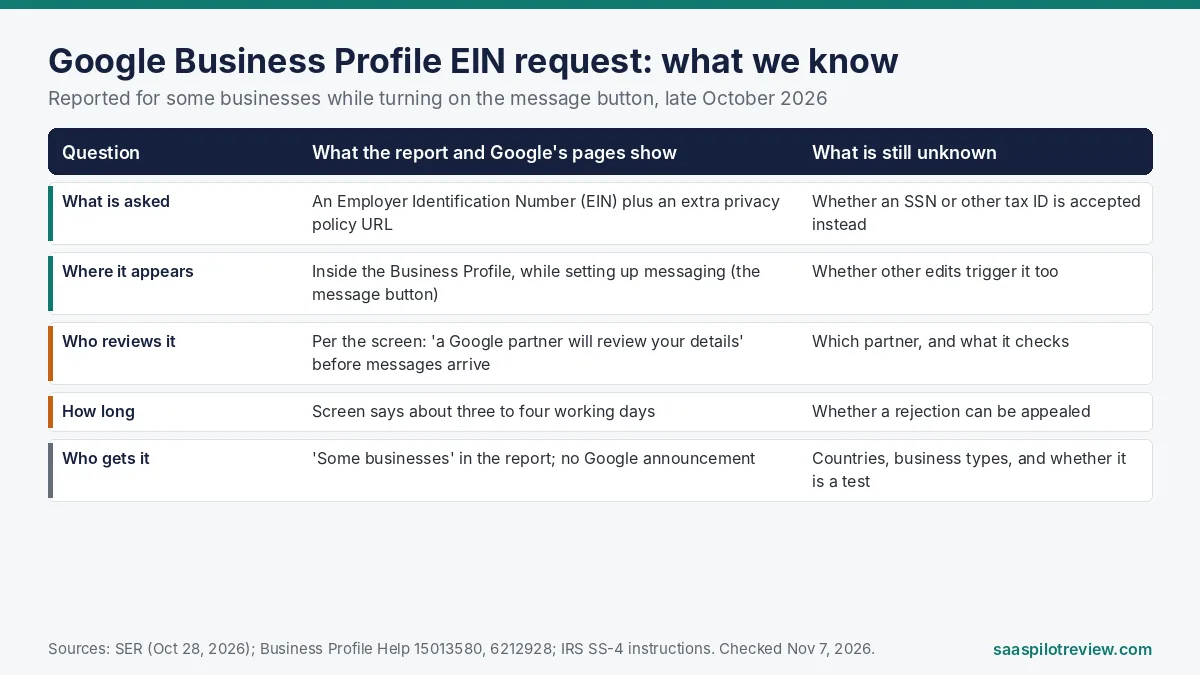
November 7, 2026 · What changed: on October 28, 2026, Search Engine Roundtable reported that Google Business Profile is asking some businesses for an Employer Identification Number (EIN) and an extra privacy policy URL when they turn on the profile’s message button. The setup screen says a Google partner reviews the details first, which takes about three to four working days. Google has not announced it.
If you run a plumbing, cleaning or landscaping business and a box asking for your EIN just appeared in your Business Profile, you are not alone, and it is not necessarily a scam. It is also not something you have to answer today. This guide covers what the Google Business Profile EIN request is, where it shows up, what to do if you never got an EIN, and how to tell the real screen from a fake call or text.
How we put this together: researched from the Search Engine Roundtable reports, Google Business Profile Help pages on chat, verification and fraud, and the IRS instructions for Form SS-4, all read on November 7, 2026. We have not seen the request on a profile we manage, so everything about the screen itself is reported, not tested. Our research and testing methods explain how we separate the two. Nothing here is tax or legal advice.
What Google is asking for, in plain terms
The request is two items: your business’s EIN and the web address of a privacy policy. Both appeared for a business owner who was setting up the message button in Business Profile, according to the Search Engine Roundtable report. The screenshot in that report reads: “To help protect you and your customers, a Google partner will review your details before you can receive messages.”
Three details matter for a small service business:
- It is tied to messaging, not to your listing. The report describes it during message button setup. Nothing in it says your profile, reviews or map ranking depend on the answer.
- Someone outside Google may see it. The screen names “a Google partner” as the reviewer. Google does not say which company, so you cannot read its privacy terms before you submit.
- It is not universal. The report says “some businesses.” If you open your profile and see nothing, that is expected.
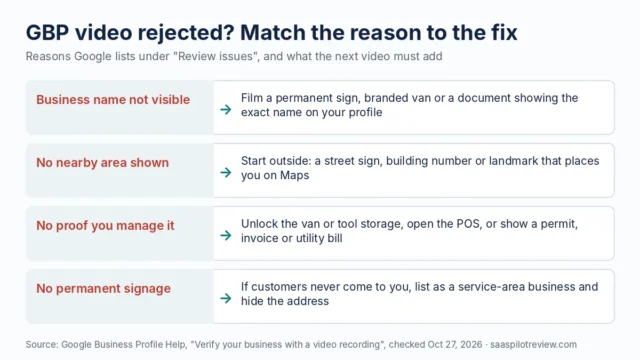
If verification itself is the problem, not messaging, start with our guide to fixing a failed Business Profile video verification instead. That is a different screen with different rules.
Where the request shows up, and where it never should
The only reported place is inside your Business Profile, while you are signed in and turning on messages. Google’s current help page on chatting with customers from your Business Profile says verified profiles can add a WhatsApp link or a phone number that receives texts under Edit profile, then Contact, then Chat, and that chat options are “currently available for select regions.” That page does not mention an EIN, a privacy policy or a partner review yet, which is one reason we treat the new screen as a test.
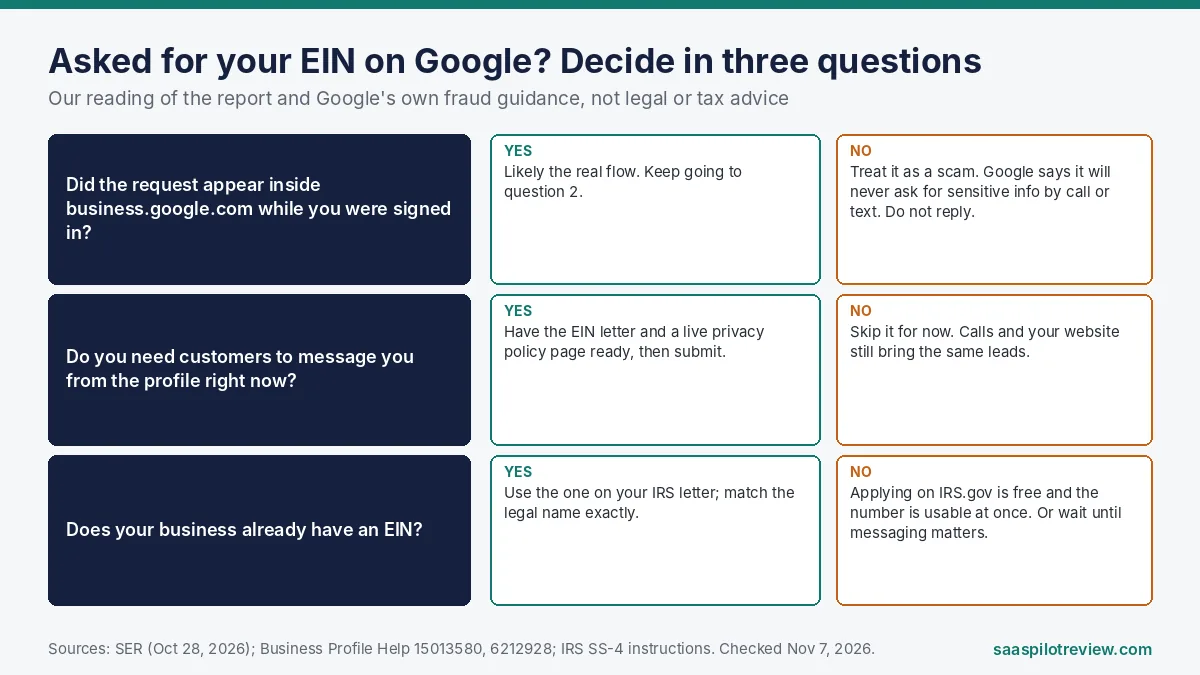
The places it should never appear: a phone call, a text, a WhatsApp chat or an email asking you to read out or type in your tax ID. Google’s page on fraudulent calls and texts says “Google will never ask you for private or sensitive information,” tells you to hang up on anyone claiming to be Google, and says not to click links in suspicious texts.
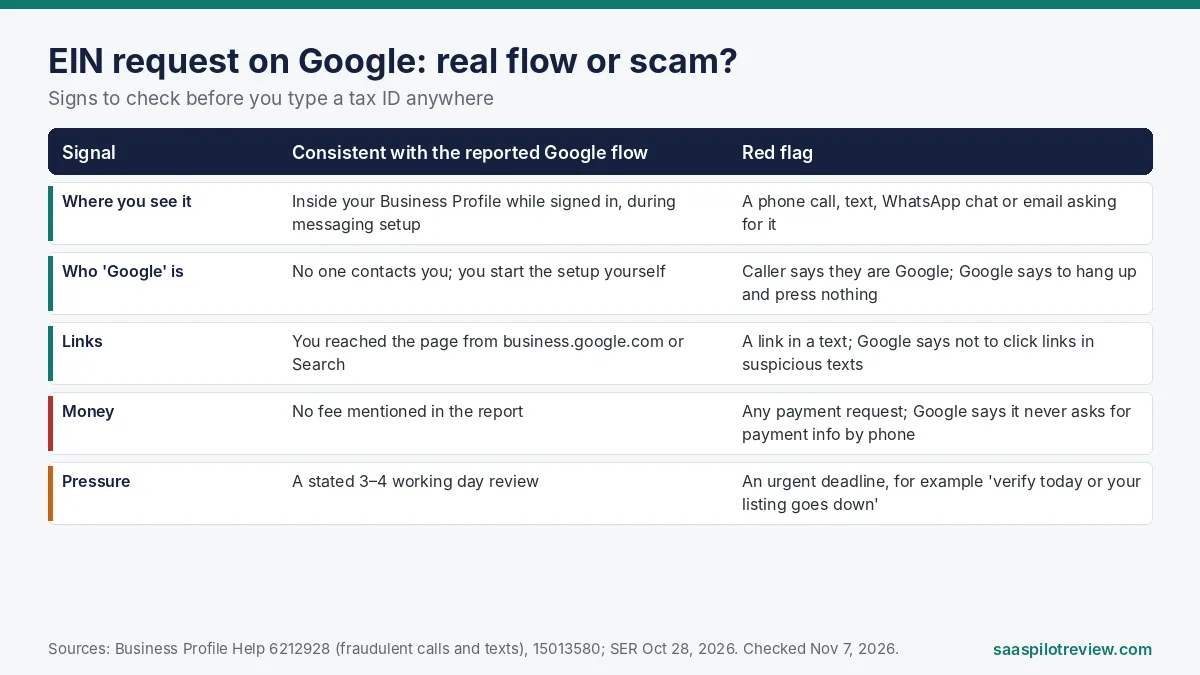
Scammers already copy Google’s verification language, and news of a real EIN request gives them a fresh script. Expect calls that say “Google needs your EIN to keep your listing live.” The real flow, as reported, starts because you clicked something in your own dashboard.
How Business Profile messaging got here
This is the latest step in a messaging feature Google has switched off, rebuilt and tested in public over two years.
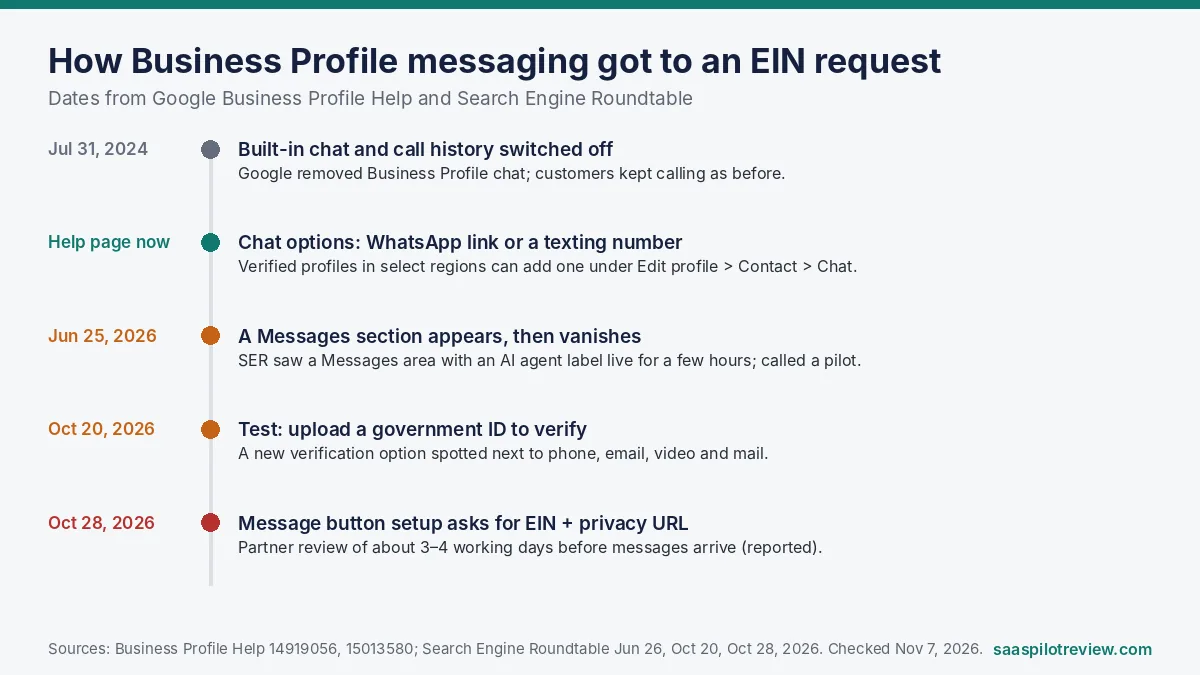
- July 31, 2024: Google’s help notice confirms the built-in chat and call history features were removed from Business Profile. We covered the call-tracking side of that in four ways to track calls after GBP call history went away.
- Current help page: chat comes back as a pointer to WhatsApp or a texting number you already run, not a Google inbox.
- June 25, 2026: SER saw a Messages section with an AI agent label appear in the dashboard for a few hours and then disappear.
- October 20, 2026: a separate test lets some owners verify by uploading a government ID.
- October 28, 2026: the EIN and privacy policy request appears in message button setup.
Our read: Google appears to be building a messaging channel again and adding identity checks before businesses can receive messages through it. That fits a broader pattern where Google wants stronger proof of who runs a profile. Google has not confirmed any of this, so treat it as a direction, not a plan.
No EIN? Options for one-person trades businesses
Plenty of owner-operators have never applied for an EIN. The IRS instructions for Form SS-4 list the situations that call for one, such as having employees or filing certain returns, and a solo cleaner or handyman often falls outside them. That leaves three choices:
- Skip messaging for now. Calls from your profile, your website and your existing text-back setup are not affected by this screen. For most trades, a missed call is a bigger leak than a missing message button.
- Get an EIN. The SS-4 instructions say US businesses can “apply for and receive an EIN free of charge on IRS.gov” and use it immediately. Anyone charging you for an EIN is a third-party filing service, not the IRS.
- Wait and watch. We do not know whether Google accepts another tax ID or a Social Security number for sole proprietors. If the field will not take what you have, that is your answer for now.
The same EIN question comes up when you register business texting. Our guide to registering A2P 10DLC without an EIN shows the sole proprietor route carriers offer and its limits, which is a useful comparison if you are deciding whether an EIN is worth getting at all.
The privacy policy URL: what to have ready
The request asks for “an additional privacy policy URL,” meaning a page on your own website. Google has not published what the reviewer checks, so we cannot give you a pass list. What we can say is what a plain policy for a small service business usually covers when customers message you:
- who you are, with the same business name and address as your profile;
- what you collect from a message (name, phone, address, job details, photos);
- what you use it for (quotes, scheduling, reminders) and whether you text people back;
- who else handles it, for example your scheduling app or texting provider;
- how a customer asks you to delete their details, with a real email or phone number.
Put it at a simple address such as yoursite.com/privacy, link it in your site footer, and make sure it loads on a phone. A dead link is the easiest way to fail a manual review.
Should you hand over your EIN? Our take
If the request appears inside your own signed-in dashboard and you want customers to message you from Google, giving an EIN is a reasonable trade. An EIN is a business identifier many owners already give to banks and payment processors, and it is not the same exposure as a Social Security number.
If you do not need messaging, there is no reported benefit to submitting it early. Nothing in the report or Google’s help pages links the EIN to rankings, reviews or verification of the listing itself. Sites claiming it “boosts” local or AI visibility are guessing.
Before you submit, check that the legal name on your IRS letter matches the business name on your profile, or have a clear reason it differs (a DBA, for example). A mismatch is the most likely reason a partner reviewer would push back, though Google has not said so.
What we will be watching
- A Google help page. When the chat help page mentions EIN or partner review, the test has become policy. We will update this guide then.
- Who the partner is. If Google names the reviewer, you can read its data terms before submitting.
- The ID upload test. If government ID verification spreads at the same time, expect more identity checks across Business Profile in 2027.
- Customer-side changes. Google is also changing what customers must do on Maps, such as signing in to read some reviews. Identity checks on both sides may be part of the same push.
More on Business Profile changes and local rankings is in our local SEO hub.
Questions owners ask
Will my Business Profile be suspended if I do not give my EIN?
Nothing in the report or Google’s help pages says so. The request is tied to receiving messages. If someone calls or texts you with that threat, follow Google’s fraud guidance and hang up.
Is the EIN shown publicly on my profile?
The report does not say it is displayed, and Google has not published how it is stored. The screen says a partner reviews it before messages turn on.
Can I use my Social Security number instead?
Unknown. The reported field asks for an EIN. We would not enter an SSN into any form that did not clearly ask for one.
How long until messages work after I submit?
The setup screen in the report says about three to four working days.
Sources (read November 7, 2026): Search Engine Roundtable, “Google Business Profiles Asking Some Businesses For an EIN” (October 28, 2026), message button (June 26, 2026) and government ID verification (October 20, 2026); Google Business Profile Help, “Chat with customers from your Business Profile,” “Help protect against fraudulent calls and texts” and the chat and call history removal notice; IRS, Instructions for Form SS-4.