How this page was made: researched from My AI Front Desk’s pricing page, its Terms of Service and its older pricing fact sheet, not hands-on tested. We have not run My AI Front Desk (now branded Frontdesk) on a live business line. Prices checked 2026-11-17 (US, USD, before tax).
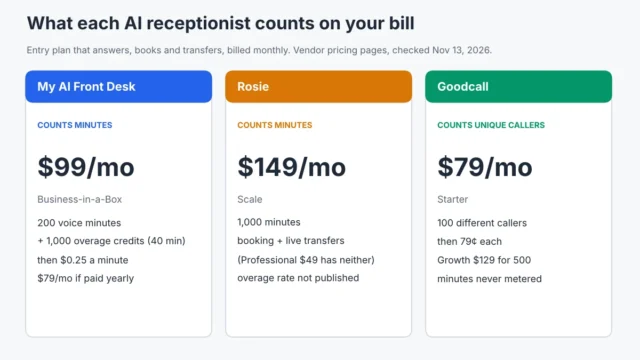
My AI Front Desk now sells one self-serve plan that answers calls: Business-in-a-Box at $99 a month, or $79 a month billed annually, with 200 voice minutes. Everything above that is custom Partner or Enterprise pricing. The number most comparison pages get wrong is the overage: the current rate is 25 credits, or $0.25, per extra voice minute, about double the $0.12 that an older company fact sheet still lists. If you are weighing it against rivals, our Goodcall vs Rosie vs My AI Front Desk comparison puts the three side by side at 100 and 300 calls a month.
The plans on the pricing page today
| Plan | Billed monthly | Billed annually | Voice minutes | Sized for |
|---|---|---|---|---|
| Business-in-a-Box | $99/mo | $79/mo (20% off, paid upfront) | 200 per month | 1 to 10 interactions a day |
| Partner / Enterprise | Custom | Custom | Custom | 25+ interactions a day, agencies |
Source: My AI Front Desk pricing page. Business-in-a-Box starts with a 7-day free trial, and the page says there are no contracts and no per-seat or per-call fees. The pricing FAQ also answers a question you may have from older reviews: “There are no separate Starter or Pro tiers.”
Beyond voice, the $99 plan includes a monthly allowance on every other channel: 100 website chatbot conversations, 400 SMS messages, 500 AI-drafted emails, 300 website form submissions and unlimited sequence automations. That bundle is the vendor’s main pitch: phone answering, chat, two-way texting and a built-in CRM in one bill.
What 200 minutes means for a service business
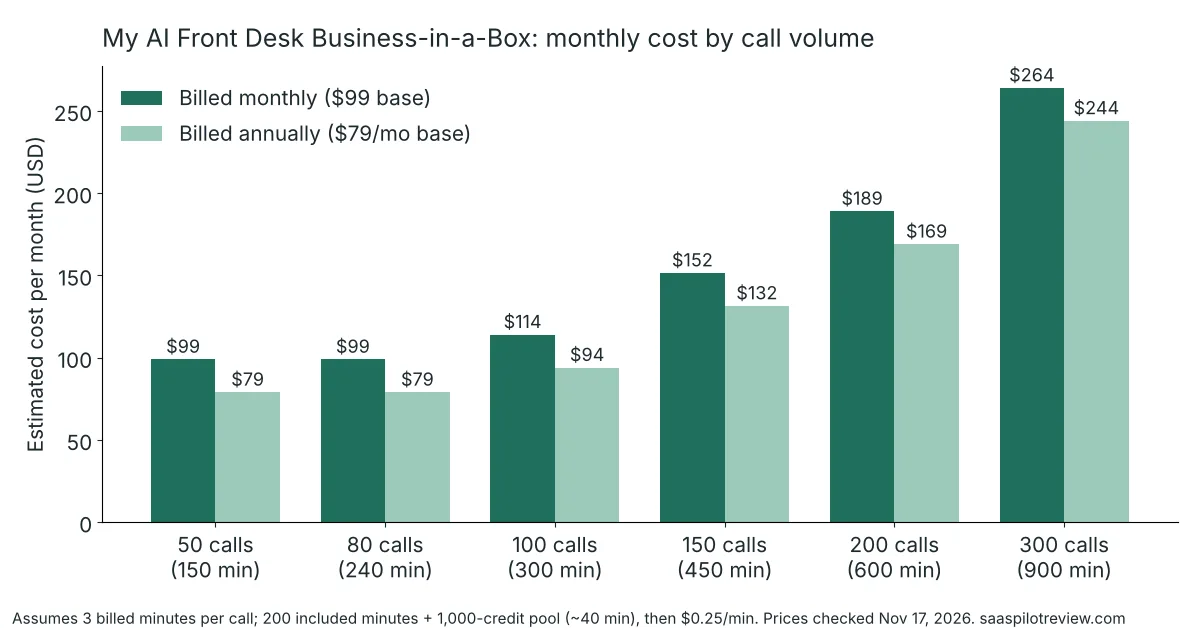
Minutes run out faster than most owners expect, because short calls add up: a 40-second “are you open Saturday?” still uses minutes. We use 3 billed minutes per call across our AI receptionist pages, which makes the included 200 minutes worth roughly 65 calls. Add the overage credit pool (next section) and the $99 covers about 80 calls a month before you pay anything extra.
| Calls answered per month | Billed minutes (3 per call) | Monthly billing | Annual billing |
|---|---|---|---|
| 50 | 150 | $99 | $79 |
| 80 | 240 | $99 | $79 |
| 100 | 300 | $114 | $94 |
| 150 | 450 | $151.50 | $131.50 |
| 200 | 600 | $189 | $169 |
| 300 | 900 | $264 | $244 |
These are our estimates from the published rates, not quotes. A two-truck plumbing shop that only sends after-hours calls to the AI often sits in the first two rows. A five-tech HVAC company sending every call to it in July can land in the last row, at which point the vendor’s own guidance (25+ interactions a day) points to a custom plan. To see what the calls you miss today are worth before you spend anything, try our missed call cost calculator.
The credit pool and the $0.25 overage minute
Overage on Business-in-a-Box is paid in credits, where 1 credit is $0.01. Each plan gets a pool of 1,000 overage credits a month, and the pricing FAQ says what happens past 200 minutes: “each extra minute draws 25 credits ($0.25) from the plan’s monthly pool of 1,000 overage credits, which covers about 40 more minutes.”
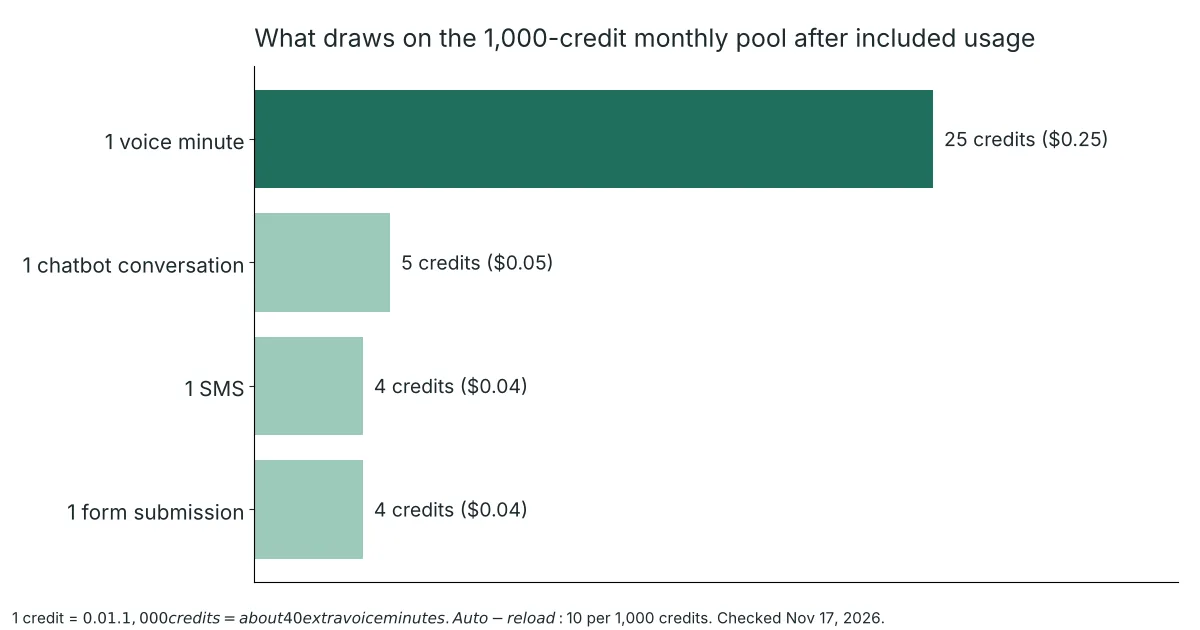
- Voice or web voicebot: 25 credits per minute ($0.25).
- Chatbot: 5 credits per conversation ($0.05).
- SMS: 4 credits per message ($0.04).
- Form submission: 4 credits per lead ($0.04).
Two rules change the real bill. First, unused pool credits expire at the end of each month, so a quiet month does not bank minutes for a busy one. Second, when the pool is empty, auto-reload adds 1,000 credits for $10, and purchased credits never expire. Because reloads come in $10 blocks, the card charge can run a few dollars ahead of the usage cost in our table: at 100 calls you use $15 of extra minutes, but two reloads charge $20 and the leftover 500 credits roll into next month.
The pool is shared across channels. A cleaning company that texts every caller a booking link and a reminder can go past the 400 included SMS, and those extra texts draw from the same 1,000 credits that would otherwise cover 40 voice minutes.
Old fact sheet vs current page: which numbers to trust
If you searched this before, you may have seen Starter and Pro plans. My AI Front Desk’s own pricing and usage fact sheet still describes them, “as of December 2, 2025”: Starter at $99 a month ($79 annually), Pro at $149 ($119 annually), and overage at $0.12 per voice minute.
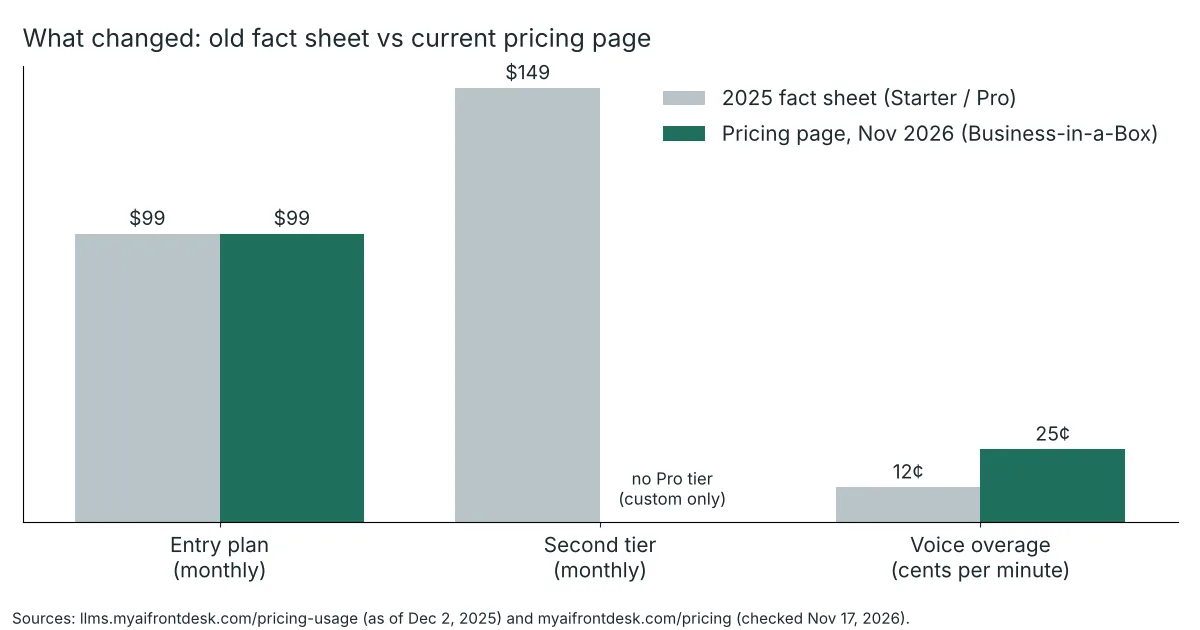
The live pricing page is newer, and the fact sheet itself says to check the pricing page for live details. So: the entry price is unchanged at $99, the Pro tier is gone, and the overage rate on the self-serve plan is now $0.25 a minute. Features that the fact sheet tied to Pro, such as API access, now sit in Partner and Enterprise. Third-party pricing pages that still quote $0.12 a minute or a $149 Pro plan are working from the old sheet.
Limits that matter more than the price
The comparison table on the pricing page lists caps that a field service owner should read before signing up:
- Call history: data retention is the “last 200 logs” on Business-in-a-Box. At 100 calls a month, that is about two months of transcripts. Save anything you need for disputes or training.
- Outbound calls: 20 a day, described as a hard daily cap. Fine for reminders, tight for a reactivation campaign.
- People: 2 editor seats and 3 notification recipients, with unlimited view-only seats. A shop with an owner, an office manager and three on-call techs cannot alert all five.
- Integrations: Zapier on every plan; direct API access and custom integrations only on Partner and Enterprise.
- Knowledge base and actions: 20 pages, and “2 of each” agent action type (transfer, text, lookup, push to another app).
Trial, cancellation and refunds
From the Terms of Service (last updated October 18, 2026):
- If you keep using the service after the trial, the subscription starts and your card is charged. Section 12 also says you are “still responsible for usage fees” during a free trial, and the pricing page notes that trial usage and charges depend on the plan.
- You can cancel any time in account settings or through support; access runs to the end of the billing period.
- Fees are non-refundable except where the law requires or at the company’s discretion, and subscription and usage fees can change with prior notice. Tax is added on top.
Our advice for the trial week: forward only after-hours calls at first, check your usage every day, and switch auto-reload off until you know your volume.
How it compares, and our take
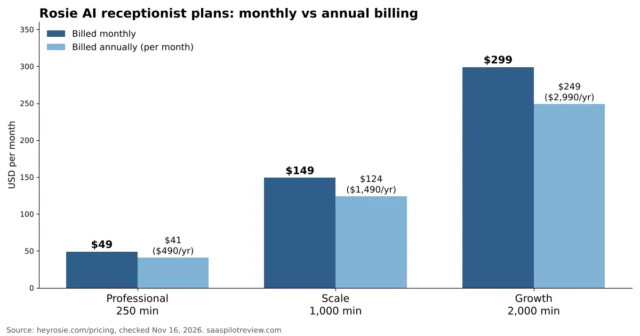
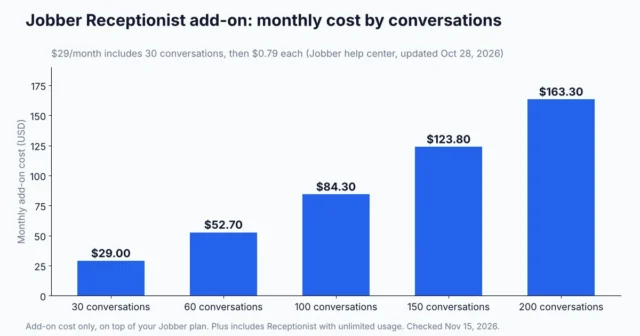
At 100 calls a month we estimate $114 on My AI Front Desk. Rosie would put the same 300 billed minutes on its $149 Scale plan, as our Rosie pricing breakdown explains, while a Jobber shop can add Jobber’s $29 AI Receptionist to the software it already pays for. On our 3-minute assumption, My AI Front Desk is cheaper than Rosie from about 85 to 145 calls a month, while Rosie’s $49 plan wins below 250 billed minutes if you only need messages taken. My AI Front Desk also bundles web chat, two-way texting and a CRM in the base price, where Rosie charges $50 a month for its website texting add-on. Its weak spots are the short call history, the 3-person notification cap and an overage rate that has doubled since its own fact sheet was written.
Start on monthly billing and move to annual ($79) only after a busy season shows your real volume. If your calls regularly pass about 200 a month, ask for a Partner quote, since the vendor lists enterprise voice from 7 credits a minute. For the wider field, see our best AI receptionists for small business and the AI receptionist vs answering service guide; every plan price we track is on the home service software price tracker, and the rest of our coverage is in the AI receptionist hub. How we research and test: how we test.