Sooner or later a caller will stop mid-sentence and ask your AI receptionist, “Wait, am I talking to a real person?” What happens next is partly a legal question and partly a customer one. For most small service businesses the answer to both is the same: have the AI say it is an AI, early, in plain words, and make it easy to reach a person.
This guide is based on research, not a test account. We read the state laws, the FCC ruling, vendor help pages and one large vendor dataset on October 21, 2026. It is not legal advice; if you work in a licensed field such as healthcare, finance or law, check with your own attorney. If you are still deciding whether software or people should answer your phone at all, start with our comparison of an AI receptionist vs an answering service.
Is it legal for an AI receptionist to sound human and not say so?
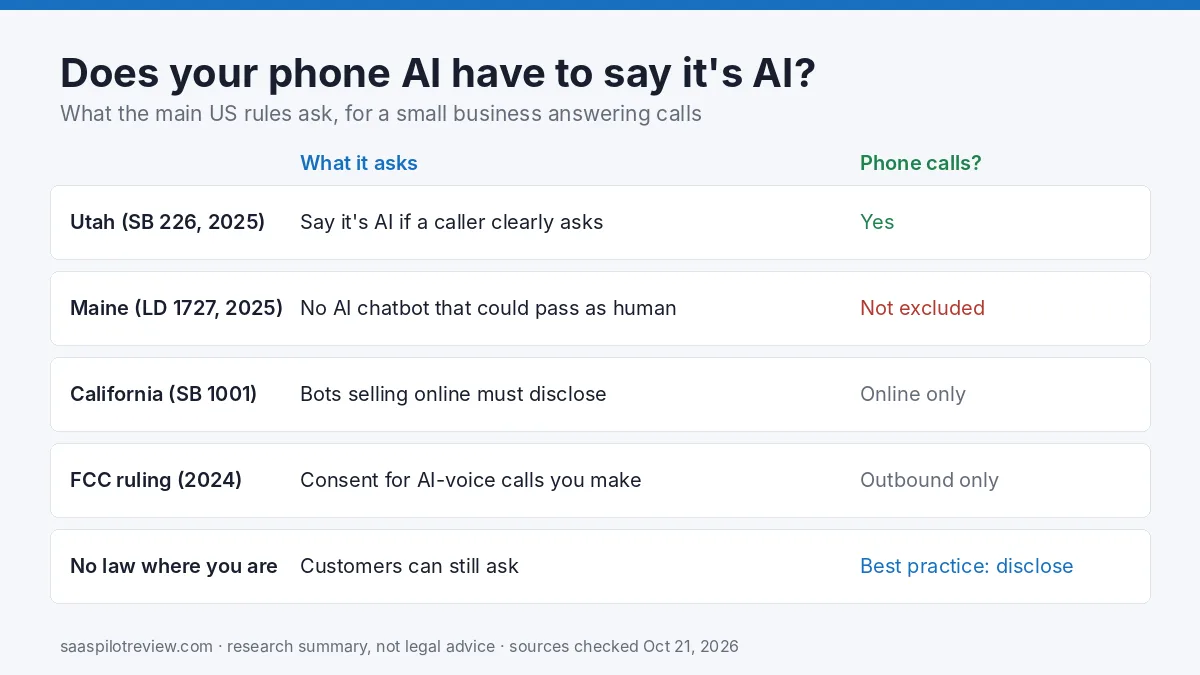
There is no single federal rule that makes every inbound AI receptionist announce itself. Whether you must disclose depends on the state you and your callers are in, what the AI does on the call, and whether the AI also makes outbound calls. Three state laws matter most for a small business today.
| Rule | What it asks | Does it reach a phone AI? |
|---|---|---|
| Utah, SB 226 (in force May 7, 2025) | If a person clearly and unambiguously asks whether they are dealing with AI, the business must say they are talking to generative AI and not a human. Licensed occupations must disclose up front, by voice at the start of a call, when the AI collects sensitive health, financial or biometric data or gives personalized advice people rely on for big decisions. | Yes. The law covers generative AI in consumer transactions, with no carve-out for voice. |
| Maine, LD 1727 (Public Law 2025, chapter 294) | A business may not use an AI chatbot in trade in a way that may lead a reasonable consumer to believe they are dealing with a human, unless the consumer is told they are not. | The law says “chatbot” and does not exclude voice. We would not count on a phone exemption. |
| California, SB 1001 (Business and Professions Code 17941) | No bot may talk to people in California online with intent to mislead them about its artificial identity to push a sale, unless it discloses that it is a bot, clearly and conspicuously. | The text says “online”. It clearly reaches your website chat widget; a plain phone line is less certain. |
Utah also gives businesses a safe harbor: if the AI says at the start of the conversation, and keeps it clear throughout, that it is generative AI, “not human”, or “an artificial intelligence assistant”, it is protected. Fines under the Utah law run up to $2,500 per violation. Colorado’s 2024 AI Act, often quoted in vendor blogs, was repealed and replaced by SB 26-189 in May 2026; law firm summaries of the new law describe notice duties for automated decision tools used in consequential decisions such as lending or housing, not a general rule for answering phones.
The practical reading: one sentence at the start of every AI conversation, by phone or chat, satisfies all three laws, costs you nothing, and saves you from tracking which state each caller is in.
What the FCC’s AI voice ruling does and does not cover
The FCC ruling covers calls you place, not calls you answer. On February 8, 2024 the FCC ruled that AI-generated voices count as an “artificial” voice under the Telephone Consumer Protection Act, the same law that governs robocalls. Calls to consumers made with an AI voice therefore need the same prior consent as a prerecorded robocall, and the caller must identify the business at the start.
That matters if your AI receptionist also makes outbound calls: estimate follow-ups, appointment reminders by voice, or win-back calls to old customers. Those calls need consent on file before the AI dials. Texts are the safer default for reminders. An inbound call where a customer rings you and the AI picks up is not a robocall.
Do callers hang up when they hear it is AI?
The best data we found says the opposite. Upfirst, an AI receptionist vendor, looked at 450,702 inbound calls to 503 of its AI receptionists, each with at least 200 real calls. Greetings that said the caller was speaking to an AI were linked to about 20% lower hang-ups. Greetings that mentioned call recording were linked to about 30% lower hang-ups.
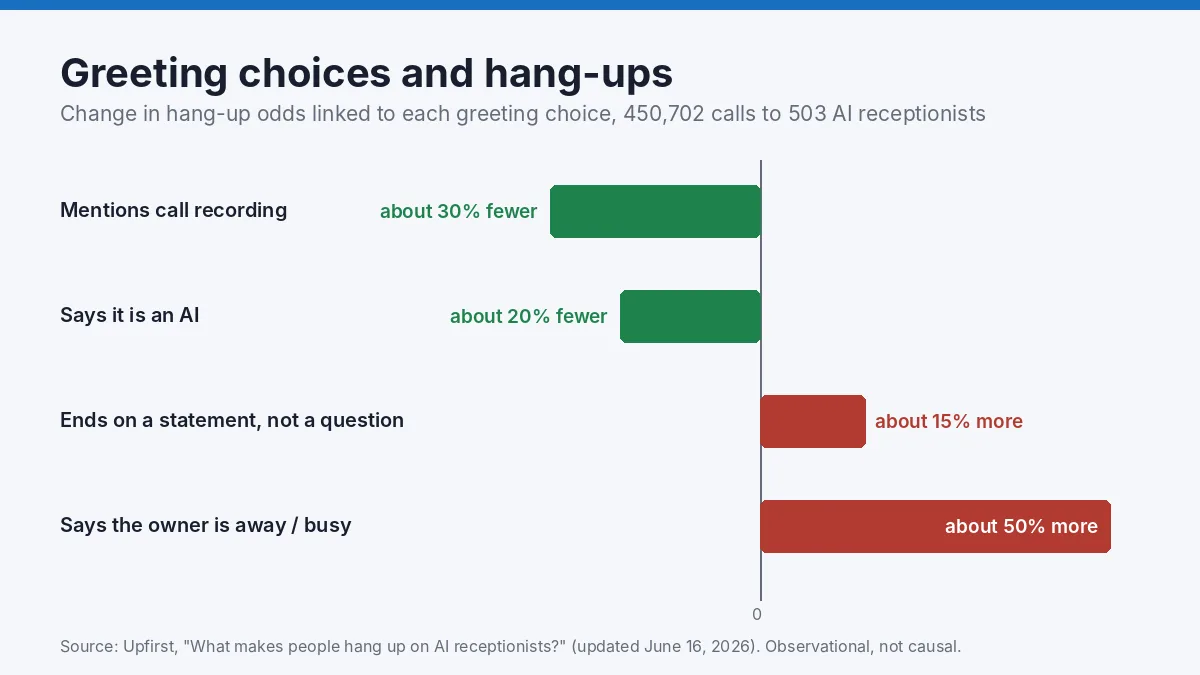
Two other findings are worth copying. Greetings that said the owner was away or busy (“Mike asked me to take your call while he’s on a job”) had about 50% higher odds of a hang-up, and greetings that ended on a statement instead of a question had about 15% more. Read these numbers with care: Upfirst sells AI receptionists, the results are correlations rather than a controlled test, and the company says greeting and setup choices explain only about 13% of the gap between businesses. Most hang-ups were silent drops in the first few seconds, before the AI said much at all.
The wider survey picture explains why hiding the AI backfires. In a Gartner survey of 5,728 customers, 64% said they would prefer companies did not use AI for customer service, and their top worry was that it would get harder to reach a person. A caller who finds out halfway through that the “receptionist” is software feels misled; a caller told up front, with a way to reach a human, mostly just gets on with booking. Every hang-up is a lost lead, so it is worth knowing what each lost caller costs your business before you write the greeting.
Three greetings you can paste in
Each one names the business, says it is AI, mentions recording if your tool records, and ends on a question. Keep the owner’s whereabouts out of it.
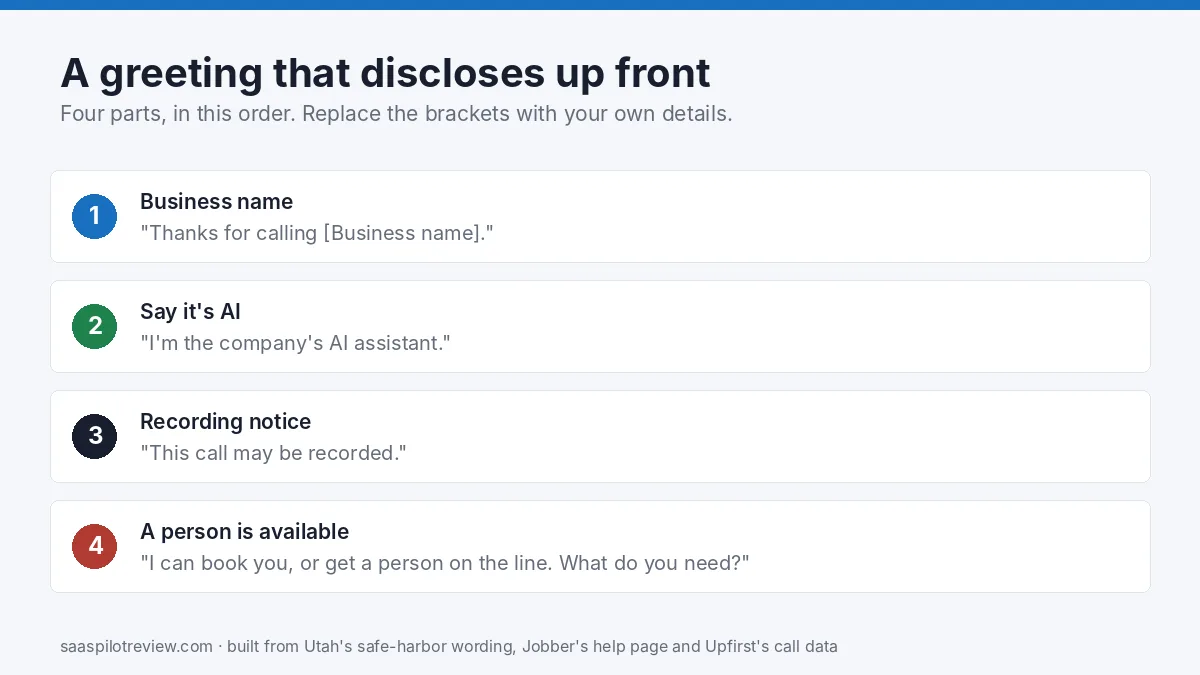
- Home services, business hours: “Thanks for calling [Business name]. I’m the company’s AI assistant, and this call may be recorded. I can book a visit or get a person on the line. What can I help with?”
- After hours or emergencies: “You’ve reached [Business name] after hours. I’m an AI assistant and this call may be recorded. If water is leaking or you have no heat, say ‘emergency’ and I’ll reach the on-call tech now. Otherwise, what do you need?”
- Short version for busy lines: “[Business name], this is our AI assistant on a recorded line. How can I help?”
If a caller asks “Are you a real person?” later in the call, the AI should answer “No, I’m an AI assistant” and offer the transfer again. Add that instruction to the tool’s training notes; Utah requires a truthful answer to that question even if your greeting said nothing.
Call recording: the disclosure owners forget
Most AI receptionists record and transcribe every call, because that is how you get the summary in your inbox. Jobber’s help page, for example, lists a call recording and a transcript for each Receptionist conversation, and says you can tell callers the call may be recorded, “but this isn’t required”, while pointing you to local and state recording rules.
Those rules are stricter in some states than the AI rules. California requires consent from everyone on a call before it is recorded, and its Supreme Court ruled in Smith v. LoanMe (2021) that this applies to a party to the call, such as a business, not just to eavesdroppers. A short “this call may be recorded” line covers you, and Upfirst’s data suggests callers do not mind hearing it.
How to set the greeting in Jobber, Upfirst and Rosie
All three let you write your own greeting, and none of the pages we read forces an AI disclosure on you. That makes the wording your call. Prices checked October 21, 2026, from each vendor’s pricing page.
| Tool | Price | Greeting control | What the vendor says about disclosure |
|---|---|---|---|
| Jobber Receptionist | $29/mo add-on; included in the Plus plan | Custom greeting read exactly as written; Casual, Professional or Brief tone; separate after-hours greeting | Help page recommends letting callers know the phone is answered by AI |
| Upfirst | From $24.95/mo (Starter, 30 calls, $1.50 per extra call); 14-day trial | Custom greeting and script | Its own call study links an AI disclosure to fewer hang-ups; example greeting says “I am an AI assistant” |
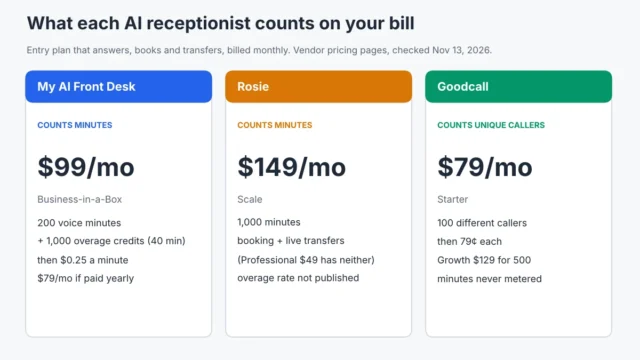
| Rosie | From $49/mo (Professional, 250 minutes); 7-day trial | Custom agent name and greeting on every plan | The pricing page does not mention disclosure; add it yourself |
One trap: a “custom agent name” such as “Sarah” is fine, but “Hi, this is Sarah” with no AI mention is exactly the setup Maine’s law targets. Use the name and the disclosure together: “This is Sarah, the AI assistant for [Business name].” For a cost comparison of these tools by call volume, see Rosie vs Upfirst vs Goodcall, and for our full shortlist, the best AI receptionist for small business.
When the AI should hand the call to a person
Disclosure works best when it comes with an exit. Set an escalation rule for the calls that should never stay with software: active leaks, gas smells, no heat in winter, an upset customer, or anyone who asks twice for a human. Jobber’s Receptionist, for instance, can transfer the call straight to an escalation contact or text them a transcript snippet when it hears trigger words such as “emergency” or “urgent”; the escalation number has to be different from the business line.
Your callers may be AI too. Google now places automated calls to some local businesses to ask about prices and availability; our guide to Google’s AI calling your business for prices covers how to handle those. More tools and guides are in the AI receptionists hub.
Questions owners ask
Can I give my AI receptionist a human name? Yes, as long as it also says it is an AI. The name alone is what creates the impression of a person.
Does saying “virtual assistant” count? Utah’s safe harbor lists “artificial intelligence assistant”, “generative artificial intelligence” and “not human”. “Virtual assistant” can also describe a remote human worker, so “AI assistant” is the clearer choice.
Do I need to disclose on texts and website chat too? Yes, if the same AI replies there. California’s bot law is written for online conversations, so the chat widget is the channel it reaches most directly.
How we researched this
We read the enacted Utah bill, Maine’s law summary, the California code section, the FCC’s announcement, Jobber’s help page and pricing, Upfirst’s and Rosie’s pricing pages, Upfirst’s call study and Gartner’s survey release on October 21, 2026. We have not set up these greetings on a live line for this page, and we do not score the tools here. Our process is on the how we test page.
Sources
- Utah Legislature: SB 226 (2025), enrolled text
- Maine Legislature: LD 1727 enacted law summary
- California Business and Professions Code section 17941
- Eckert Seamans: Colorado repeals and replaces its AI statute
- FCC: AI-generated voices in robocalls ruling (February 8, 2024)
- Wilson Sonsini: FCC rules AI-generated voices are artificial under the TCPA
- Paul Hastings: California Supreme Court on two-party consent (Smith v. LoanMe)
- Upfirst: what makes people hang up on AI receptionists
- Gartner: 64% of customers would prefer companies didn’t use AI for customer service
- Jobber Help: Receptionist powered by Jobber AI
- Jobber: pricing
- Upfirst: pricing
- Rosie: pricing