How this page was made: researched from CallRail’s public pricing page (plan cards with the Yearly and Monthly toggle, the comparison table and the pricing FAQ), not hands-on tested. We have not run CallRail on a live business line. Prices checked 2026-11-17 (US, USD, before tax).
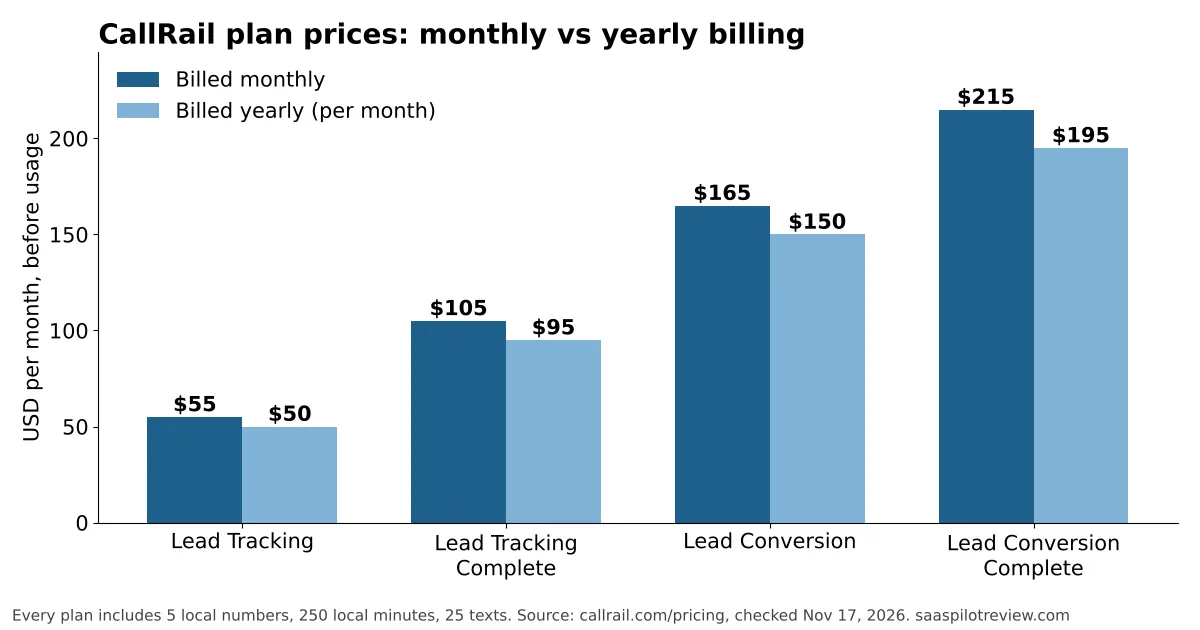
CallRail pricing starts at $55 a month for Lead Tracking on monthly billing, or $50 a month if you pay for a year up front. Every plan comes with 5 local numbers, 250 local minutes and 25 texts, and everything past that is billed as usage on the next invoice. For most small service businesses the base fee is the easy part; the bill moves with how many tracking numbers you run and how many minutes your calls round up to. If you are still deciding whether CallRail is the right tool at all, our Nimbata vs CallRail comparison runs the same kind of math for a cheaper rival.
The four CallRail plans and their two prices
| Plan | Billed monthly | Billed yearly (per month) | Paid up front per year | What it adds |
|---|---|---|---|---|
| Lead Tracking | $55/mo | $50/mo | $600 | Call and text tracking, recording, routing, transcription, automation rules |
| Lead Tracking Complete | $105/mo | $95/mo | $1,140 | Form tracking, custom form builder, multi-touch cost-per-lead reports, 1,000 form submissions |
| Lead Conversion | $165/mo | $150/mo | $1,800 | Call summaries, sentiment, trend reports, automatic conversion tagging, coaching tools, 10,000 analysis minutes |
| Lead Conversion Complete | $215/mo | $195/mo | $2,340 | Everything above in one plan |
Source: CallRail pricing page. The page opens on the Yearly toggle, which is why $50 is the number most lists quote; switch to Monthly and every card goes up. The banner says “save up to 10%,” but on the current prices the saving works out to between about 9.1% and 9.5% per plan. On annual billing the base fee for 12 months is due when you enter your card, while usage is still billed month by month.
All four plans share the same allowance: 5 local numbers, 250 local minutes (transcription included) and 25 texts a month. Higher plans do not give you more numbers or minutes; they add reporting and call analysis. A 14-day free trial needs no card, and texting only switches on after the trial.
Usage rates once the allowance runs out
Past the allowance, CallRail bills each unit at the rates in its comparison table. As of November 17, 2026 these are the same on every plan:
| Usage item | Included each month | Price past the allowance |
|---|---|---|
| Local tracking numbers | 5 | $3 per number |
| Local minutes (includes transcription) | 250 | $0.06 per minute |
| Toll-free numbers | 0 | $5 per number |
| Toll-free minutes | 0 | $0.09 per minute |
| Text messages | 25 | $0.03 per text |
| Form submissions (Complete plans) | 1,000 | $0.02 per submission |
| Analysis minutes (Conversion plans) | 10,000 | $0.05 per minute |
Two per-minute rates, two different meters. The 6 cents is for phone minutes on local numbers; the 5 cents is for analysis minutes, the AI layer on Conversion plans. They are easy to mix up because both sit in the same table. You may also see 5 cents and 8 cents quoted for local and toll-free minutes on third-party price lists; the live table on our check date shows 6 and 9 cents, so budget on those.
Why your call log undercounts billed minutes
The billing FAQ on the pricing page says minutes are calculated “by rounding each call up to the nearest minute and then summing the minutes.” A 15-second hang-up costs a full minute; a 2-minute 10-second call costs three.
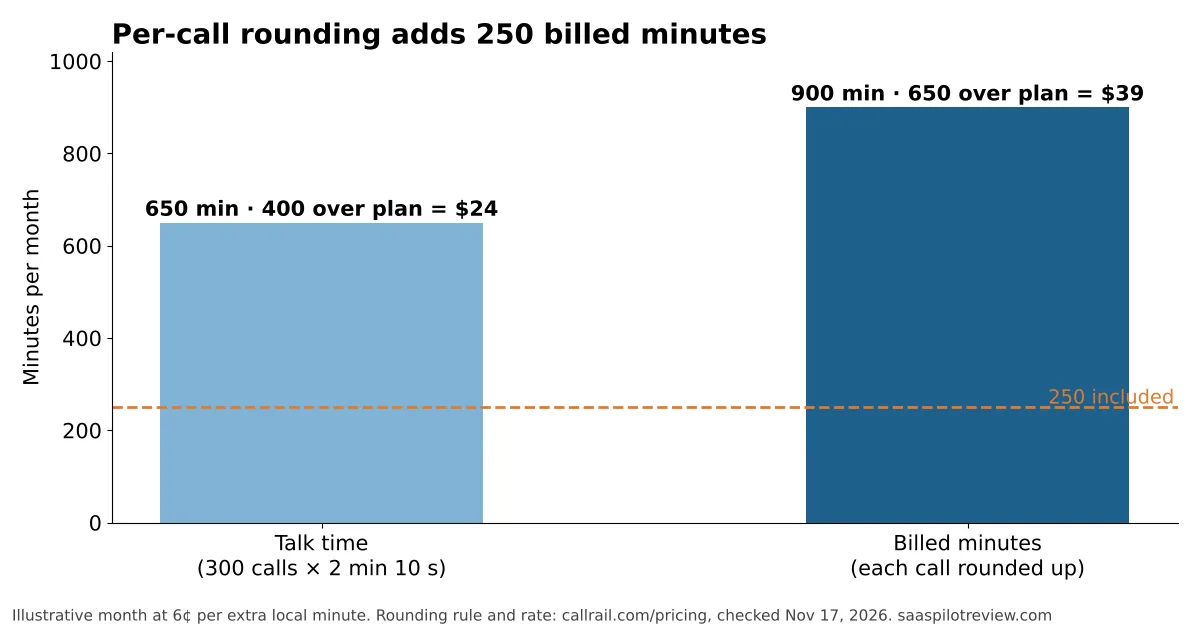
Take a shop that tracks 300 calls a month averaging 2 minutes 10 seconds. That is 650 minutes of talk time, or 400 over the allowance and $24 of overage. Rounded up per call, it is 900 billed minutes, 650 over, and $39. The difference is small in dollars, but it compounds for businesses with many short calls: spam, hang-ups and “are you open today” calls each count as a whole minute. When you size a plan, multiply your call count by your average call length rounded up, not your total talk time.
Three monthly bills, worked out
These are our own examples using the list rates above. They assume local numbers only and calls that average just over 2 minutes, so each bills as 3 minutes.
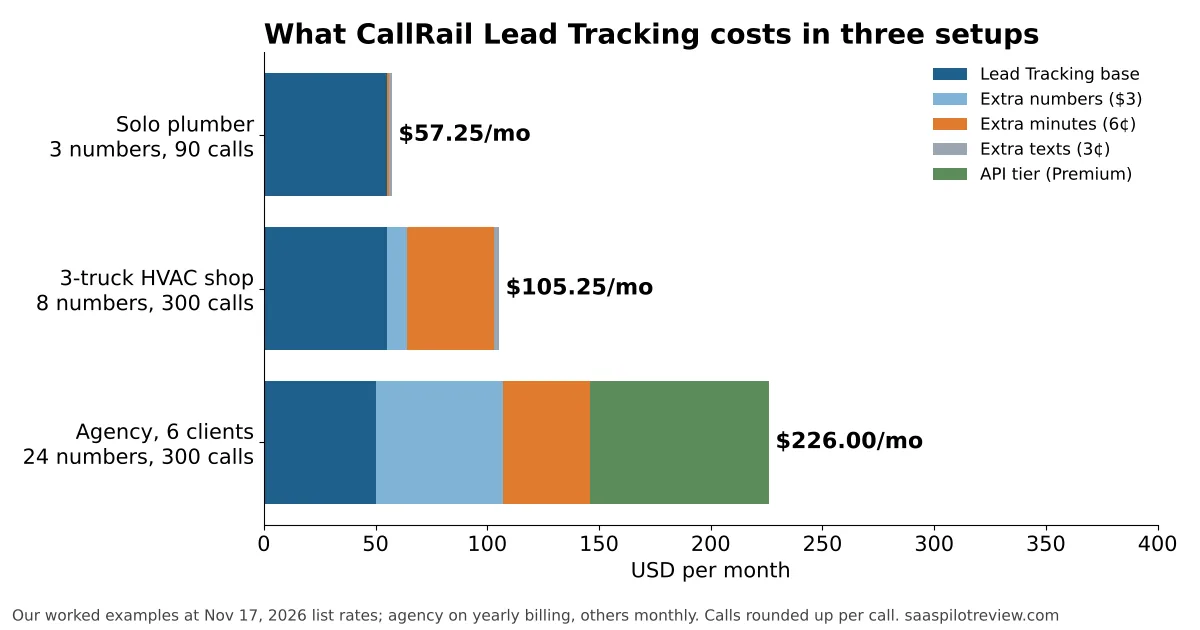
| Line item | Solo plumber | 3-truck HVAC shop | Agency, 6 local clients |
|---|---|---|---|
| Setup | 3 numbers (Google profile, website, truck), 90 calls, 60 texts | 8 numbers (website pool, Google Ads, Google profile, LSA, mailers), 300 calls, 100 texts | 24 numbers (4 per client), 300 calls, hourly API sync to a dashboard |
| Lead Tracking base | $55 (monthly) | $55 (monthly) | $50 (yearly) |
| Extra numbers at $3 | $0 | 3 × $3 = $9 | 19 × $3 = $57 |
| Extra minutes at $0.06 | 270 billed, 20 over = $1.20 | 900 billed, 650 over = $39 | 900 billed, 650 over = $39 |
| Extra texts at $0.03 | 35 over = $1.05 | 75 over = $2.25 | $0 |
| API tier | $0 | $0 | 6 clients × 720 requests = 4,320 a month, Premium tier = $80 |
| Monthly total | $57.25 | $105.25 | $226.00 |
The solo plumber barely moves past the base fee. The HVAC shop pays almost double the sticker price, and two-thirds of the extra is minutes, so per-call rounding matters more to it than the plan choice. For the agency the biggest single line is not numbers or minutes but the API tier, which is new this autumn. Our breakdown of CallRail’s API overage tiers shows which sync setups stay free and which trip the $80 and $200 levels.
Seasonal trades should size for the busy month. The HVAC shop above, at 500 calls in July, would bill about 1,500 minutes and pay roughly $75 in minute overage alone that month, with the same base fee.
Costs that sit outside the plan card
- Advanced call flow steps: $15 per company per month on every plan, per the expanded comparison table. Agencies that build menus or schedules for each client pay it once per client company.
- Premium integrations: Salesforce, Marketo, Marin, Kenshoo, Acquisio and Optimizely X are listed at $80 each per month. Jobber, Housecall Pro, ServiceTitan, HubSpot, Google Ads and GA4 appear in the same table with no separate price.
- API usage: free up to 1,500 API calls a month, $80 a month from 1,501 to 12,000, $200 a month from 12,001 to 300,000, billed on the previous period’s usage.
- Voice Assist: CallRail’s AI answering add-on starts at $95 a month, and the footnote says it needs Lead Tracking at an additional $55, plus $1 per call after 50 Voice Assist calls over 15 seconds.
- No refunds on usage: the FAQ says additional usage fees “are not refundable under any circumstances,” and that CallRail may change fees by posting new pricing or emailing you.
- Healthcare: HIPAA customers sign a business associate agreement and are pointed to separate healthcare plans with no public price.
If you used CallRail mainly to call leads back and are weighing other options for that job, see our guide to replacing CallRail’s Lead Center softphone.
Is Complete or Conversion worth the step up?
Lead Tracking Complete costs $45 a month more than Lead Tracking on yearly billing ($50 more on monthly) and makes sense only if a real share of your leads come through website forms and you want them attributed to the same ad or listing as calls. A roofer whose quote form brings in as many leads as the phone has a case; a plumber whose leads are 90% phone calls does not.
Lead Conversion adds AI call summaries, sentiment, trend reports and automatic tagging for $100 more than Lead Tracking on yearly billing ($110 on monthly). It pays off when someone actually reads the summaries, for example an office manager coaching two CSRs on booking rate. If nobody will open the reports, the transcripts already included in Lead Tracking cover most small shops.
CallRail’s price against two rivals we cover
| Tool | Entry plan, monthly | Billed yearly | Extra local number |
|---|---|---|---|
| CallRail Lead Tracking | $55/mo | $50/mo | $3 after the first 5 |
| Nimbata Pro | $39/mo + usage | $35/mo | Per-number rate drops on higher plans |
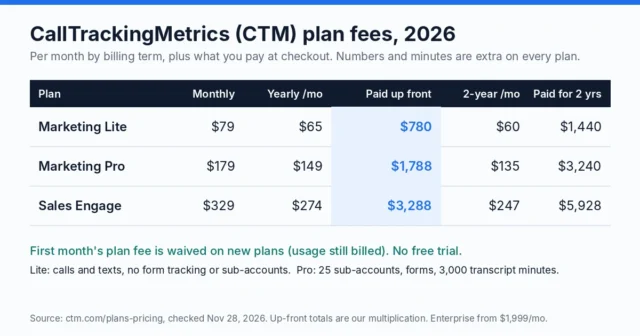
| CallTrackingMetrics Marketing Lite | $79/mo | $65/mo | From $2 |
Competitor figures come from our comparison pages, last checked before this page; open those pages for their sources and dates. For a single business, Nimbata is usually a few dollars cheaper without transcripts; for agencies, our CallTrackingMetrics vs CallRail cost table for 5 and 10 clients shows CallRail’s one-plan-for-all-clients model winning at small scale. For CTM’s own plans and usage rates, see our CallTrackingMetrics pricing guide.
What we would budget
A solo or 2-truck trade that tracks a Google profile, a website and one ad source should budget about $55 to $65 a month on monthly billing, and switch to yearly billing only after a busy season confirms CallRail is staying. A 3 to 10 truck shop running ads should plan on $100 to $130 a month on Lead Tracking, most of it minutes, and treat Lead Conversion as a second-year upgrade. Agencies should price every client at roughly $3 per extra number plus minutes, and decide up front who pays if a dashboard sync pushes the account into an API tier.
We track CallRail next to the other tools trades buy on our home service software price tracker, and the rest of our call tracking coverage is in the call tracking and lead gen hub. How we research and test: how we test.