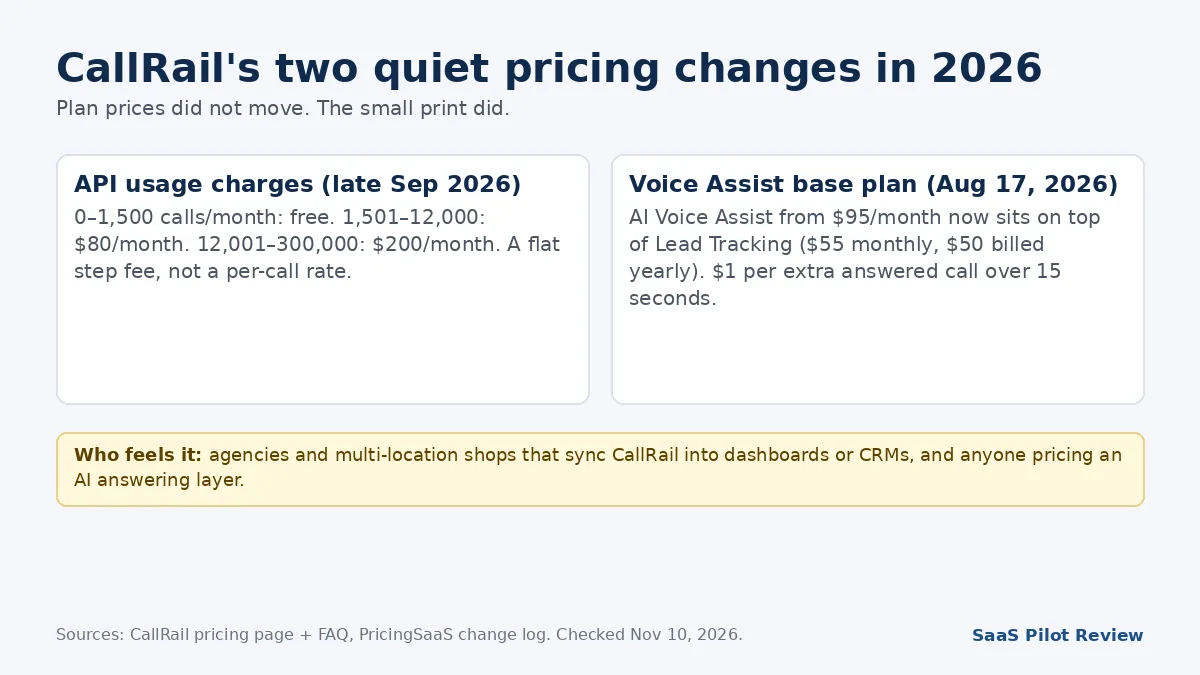
November 10, 2026 · What changed: CallRail’s pricing page now lists monthly charges for heavy API usage: free up to 1,500 API calls a month, $80 a month from 1,501 to 12,000, and $200 a month from 12,001 to 300,000. PricingSaaS first logged the new FAQ entry in the week of September 21–28, 2026. Separately, since mid-August the AI Voice Assist footnote says the add-on sits on top of a Lead Tracking plan, so the real starting cost is two line items, not one.
Neither change moved CallRail’s headline plan prices. Lead Tracking is still $50 a month billed yearly ($55 month to month), and the four plan cards look the same as they did in October. What changed is the small print, and both items land on the same kind of account: an agency or a multi-location contractor that pipes CallRail data into other tools, or one that wants an AI to pick up missed calls. If you are comparing trackers right now, our CallTrackingMetrics vs CallRail comparison for small agencies has the full plan-by-plan math; this page covers only the two new costs.
How we put this together: researched from CallRail’s public pricing page and its Help Center, read on November 10, 2026, and from the PricingSaaS change log for CallRail (weeks 34 and 40 of 2026). We have not run a CallRail account past the API thresholds or used Voice Assist, so the numbers below are CallRail’s published figures and our own arithmetic, not test results. Our research and testing methods explain the difference.
The new API charge, tier by tier
CallRail now charges a flat monthly fee once an account goes past 1,500 API calls in a month. The pricing FAQ reads: “Heavy API usage will incur additional monthly charges based on the following tiers.” It is a step fee, not a per-call rate, so the first call over each line moves the whole month into the next tier.
| API calls in a month | Extra monthly charge | Effective cost per 1,000 calls at the top of the tier |
|---|---|---|
| 0 – 1,500 | $0 | $0 |
| 1,501 – 12,000 | $80 | $6.67 |
| 12,001 – 300,000 | $200 | $0.67 |
| Above 300,000 | Not published | Ask CallRail |
Prices checked November 10, 2026, from the CallRail pricing FAQ. The last column is our arithmetic.
Before late September, the pricing page did not list API overage pricing at all. PricingSaaS, which captures vendor pricing pages each week, records the FAQ entry as new between September 21 and September 28, 2026, and describes it as disclosing “previously unpublished” pricing. That wording matters: it is possible some accounts were already being billed under these tiers before the FAQ appeared. If your invoice has an API line you do not recognize, CallRail’s guide to reading your CallRail invoice is the place to start before you open a ticket.
What counts as an API call?
CallRail’s page does not define it beyond “API usage,” and its Help Center article on plan types says only that each package tier includes “a predetermined number of included minutes/messages/API calls.” Read literally, every request to the CallRail REST API counts, including each page of a paginated call list. The page does not say whether CallRail’s own native integrations count toward the 1,500, so treat that as an open question to put to your account manager in writing.
Who will actually cross 1,500 calls a month
A single-location contractor who only uses the CallRail dashboard and the built-in Jobber or Google Ads connections will rarely touch the public API at all. The accounts at risk are the ones running a custom script, a reporting tool or an automation platform that polls CallRail on a schedule.
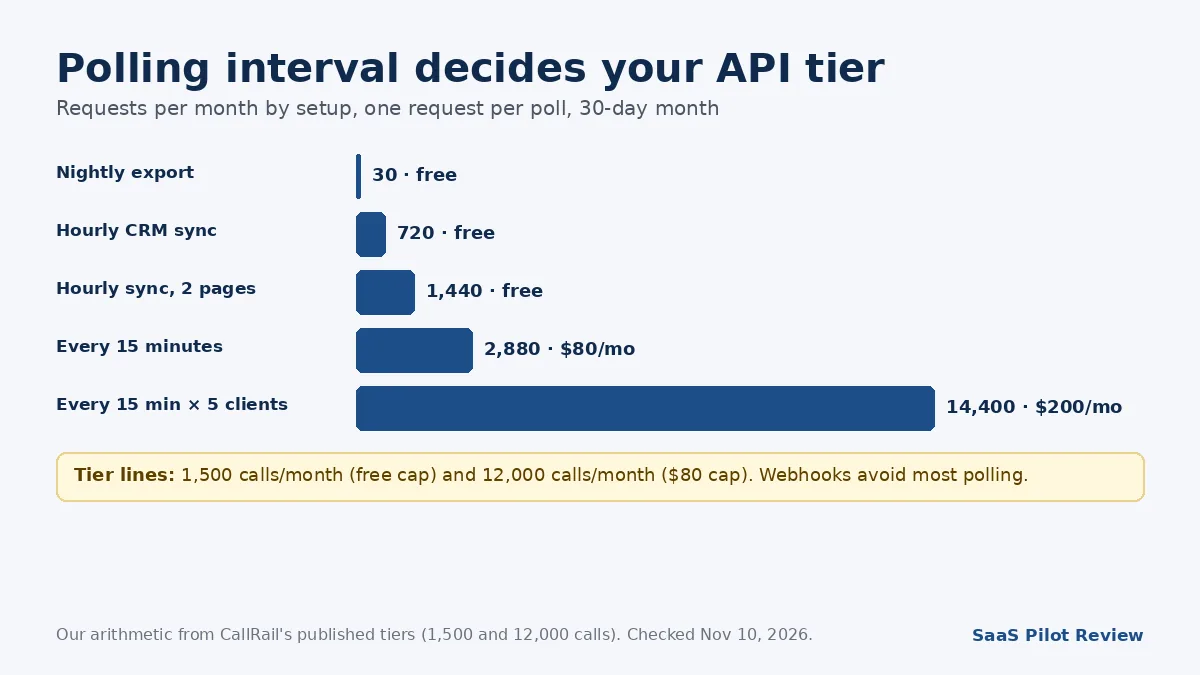
The polling interval does most of the damage. These are our own worked examples, assuming one request per poll and a 30-day month:
| Setup | Requests per month | Tier | Extra cost |
|---|---|---|---|
| Nightly export to a spreadsheet | 30 | Free | $0 |
| Hourly sync of new calls to a CRM | 720 | Free | $0 |
| Same hourly sync, 2 pages of results each time | 1,440 | Free, barely | $0 |
| Sync every 15 minutes | 2,880 | 1,501 – 12,000 | $80 |
| Every 15 minutes for 5 client companies, polled separately | 14,400 | 12,001 – 300,000 | $200 |
An agency that polls per client is the clearest case. Five clients synced every 15 minutes is already in the $200 tier, which on its own is more than four months of a Lead Tracking plan at the monthly rate. If you build client dashboards, our AgencyAnalytics vs DashThis vs Reportei comparison is worth reading with this in mind: ask each reporting vendor how often it pulls CallRail data and whether that pull runs through your API key.
Four ways to stay under the line
- Switch polling to webhooks. CallRail can push call events to a URL when they happen, which replaces hundreds of “anything new?” requests with one message per call.
- Poll less often. Moving a sync from every 15 minutes to every hour cuts requests by three quarters. Most owners do not need call data in a CRM within 15 minutes of the call.
- Ask for bigger pages. Fewer, larger list requests use fewer calls than many small ones.
- Audit old keys. A Zap or script someone set up two years ago and forgot about can quietly burn requests. Revoke API keys nobody owns.
Voice Assist now sits on top of Lead Tracking
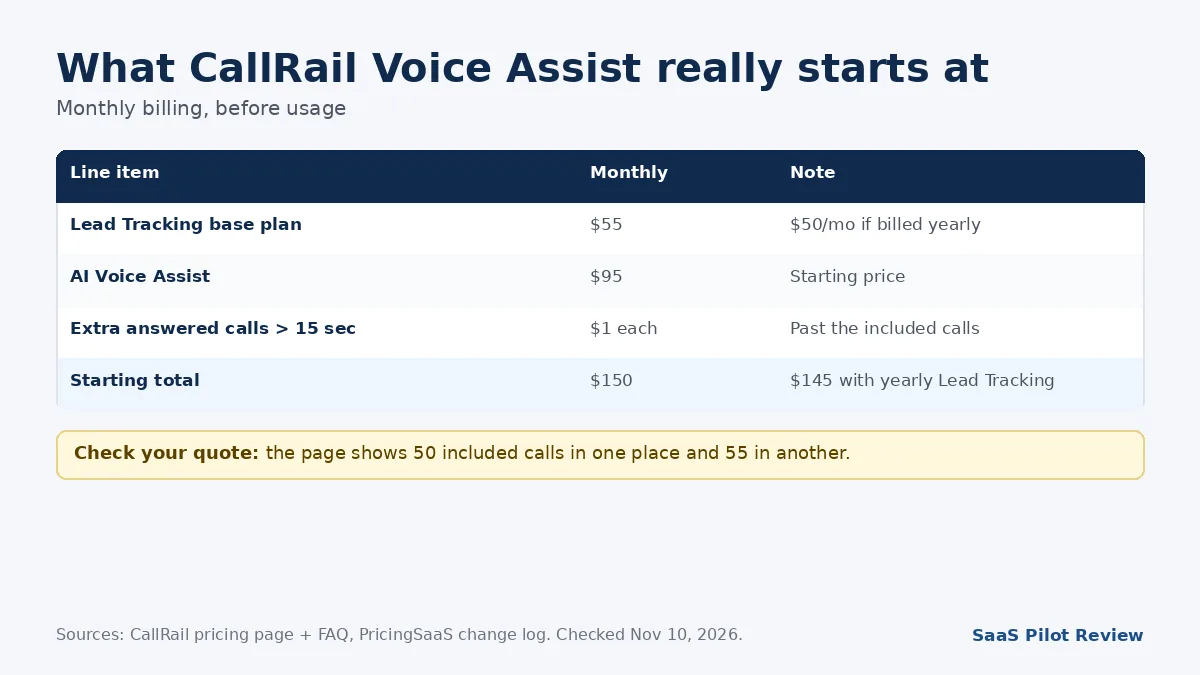
CallRail’s AI Voice Assist answers calls your team misses, asks the caller questions and passes the details back to you. The pricing page lists it from $95 a month, and its footnote says “All plans include Lead Tracking starting at an additional $55.” PricingSaaS logged that wording as new on August 17, 2026; before then, the footnote gave the $95 starting price and the per-call fee with no base plan mentioned. Calls past the included allowance that last longer than 15 seconds cost $1 each. The page shows 50 included calls in one place and 55 in another, so confirm the number on your quote.
In practice the cheapest way to get Voice Assist is two line items:
| Line item | Monthly billing | Note |
|---|---|---|
| Lead Tracking (5 local numbers, 250 minutes, 25 texts) | $55 | $50 a month billed yearly |
| AI Voice Assist | $95 | Starting price |
| Extra answered calls over the allowance, longer than 15 seconds | $1 each | Usage |
| Starting total before usage | $150 | $145 if Lead Tracking is billed yearly at $50 |
Prices checked November 10, 2026, from the CallRail pricing page. Totals are our arithmetic.
How that compares with a stand-alone AI receptionist
$150 a month is real money for a 2-truck shop, and it buys an answering layer bolted onto call tracking, not a full receptionist product. If you already pay for CallRail to track ad calls, adding Voice Assist keeps every recording, source and transcript in one place, which is the strongest argument for it. If you do not need attribution, a dedicated tool may cost less; our guide to the best AI receptionists for small businesses compares the stand-alone options, and AI receptionist vs answering service covers when a human service is still the safer pick.
What to do this week if you are on CallRail
- Check last month’s invoice for any API usage line, and note the tier.
- List every tool holding a CallRail API key: reporting dashboards, Zapier or Make, a custom CRM sync, a developer’s script.
- Ask each vendor its polling interval and whether it supports CallRail webhooks.
- If you sell CallRail to clients, decide now whether the $80 or $200 tier is passed through or absorbed, and put it in your next proposal.
- If you are pricing Voice Assist, quote $150 a month as the floor on monthly billing, not $95.
If the new charges tip the math for your agency, our list of CallRail Lead Center alternatives covers tools that bundle calls, texts and forms differently, and Nimbata vs CallRail compares a cheaper tracker plan by plan, including which Nimbata plans include API access. Everything else on call tracking lives in our call tracking and lead gen hub.
Quick answers
Did CallRail raise its plan prices in 2026?
Not the headline prices. Lead Tracking is $50 a month billed yearly or $55 month to month, the same as in October. The changes are the API usage tiers and the Voice Assist base-plan requirement.
Is the CallRail API free?
Up to 1,500 calls a month, yes. Above that, CallRail charges $80 a month up to 12,000 calls and $200 a month up to 300,000.
Can I buy Voice Assist without a CallRail plan?
Not according to the current footnote, which says Voice Assist plans include Lead Tracking at an additional cost starting at $55 a month.
Sources (read November 10, 2026): CallRail, pricing page and pricing FAQ; CallRail Help Center, CallRail’s plan types; PricingSaaS, CallRail changes, week 40 of 2026 and week 34 of 2026.