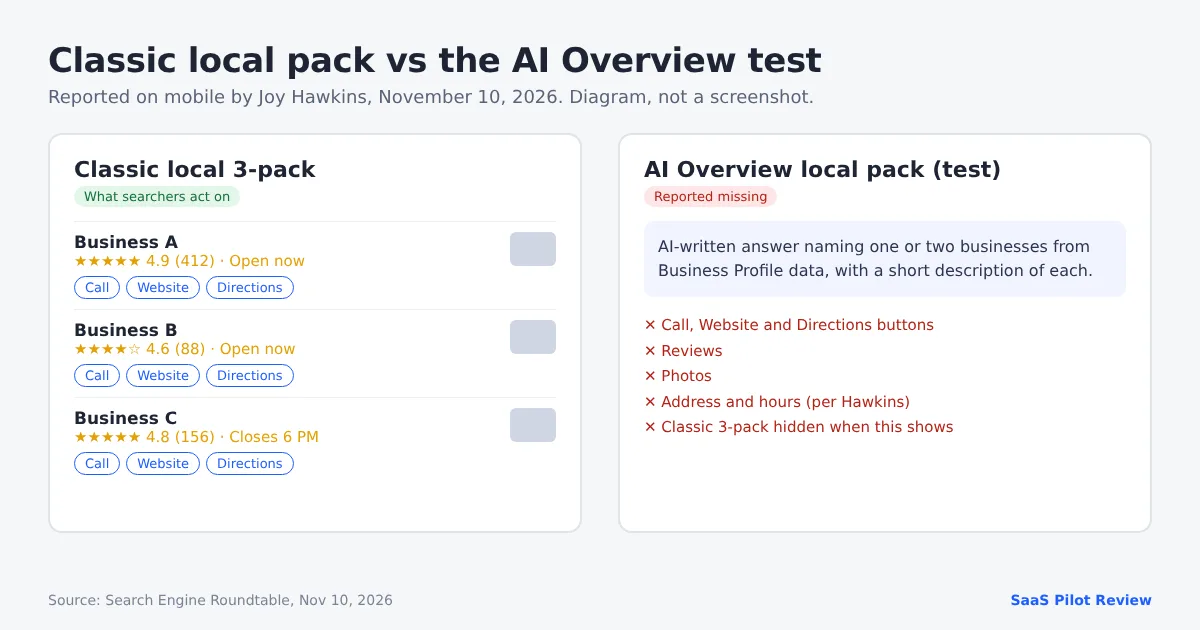
Updated November 18, 2026. What changed: On November 10, 2026, local search consultant Joy Hawkins reported a new version of Google’s AI-powered local pack on mobile that drops the call, website and directions buttons, along with reviews and photos. Search Engine Roundtable replicated it the same day. Google has not commented, so treat this as a test, not a rollout.
How this page was made: researched from Search Engine Roundtable’s report, Sterling Sky’s local changes log and its October 2026 data on AI local packs, and Google’s Business Profile help pages, not hands-on tested. We have not seen the test version on our own phones. Where a detail comes only from one observer, we say who reported it.
If most of your work comes from people tapping “Call” on Google, this test matters more than the usual weekly layout shuffle. In the reported version, a mobile searcher sees an AI-written answer that names a business or two, but the buttons that turn that answer into a phone call are gone, and so are the star ratings and photos that usually win the tap. Below is what was reported, how widespread AI local packs already are, and how a plumbing, HVAC or roofing company can tell from its own numbers whether it is losing calls. For the bigger picture on being named in AI answers at all, see our guide to getting cited in AI Overviews and ChatGPT.
What Google is testing on mobile
Google is testing an AI Overview style local pack that keeps the business names but strips almost everything a searcher uses to act on them. According to Search Engine Roundtable’s November 10 report, the test removes:
- the Call, Website and Directions buttons,
- reviews and photos,
- and, per Hawkins, the address and opening hours.
Hawkins wrote that she had been seeing the new version “in the last few days,” that it still pulls from Google Business Profile data, and that whenever it appears the traditional local pack disappears from the mobile results. She called it “probably the ugliest version of the AI Overview I’ve seen in local thus far.” Barry Schwartz, who wrote the report, said the change “cannot be good for clicks, calls and direction actions to businesses.” The report does not say whether star ratings are hidden too, and nobody has reported the test on desktop.
This is not the first time Google has tried an AI answer in the local slot. Search Engine Roundtable covered a test of an AI Overview replacing the map pack back in May 2025. What is new is how bare this version is.
How often AI local packs show up already
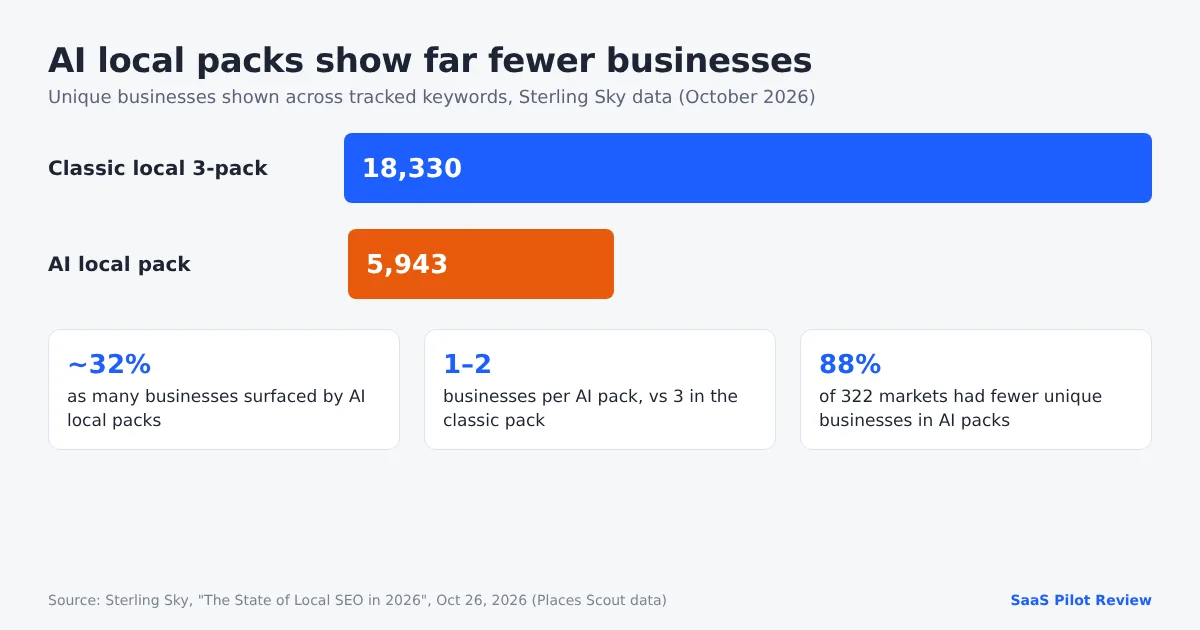
AI local packs are still a minority result, but they are not rare, and they show fewer businesses than the classic three-pack. Joy Hawkins’ agency Sterling Sky published data on October 26, 2026, from rank tracking run with Places Scout, in The State of Local SEO in 2026:
| Measure (Sterling Sky, Oct 2026) | AI local pack | Classic local 3-pack |
|---|---|---|
| Unique businesses shown across tracked keywords | 5,943 | 18,330 |
| Businesses per result | 1–2 | 3 |
| Share of tracked keywords where it appears | About 7% | Most local keywords |
| Markets (of 322) with fewer unique businesses | 88% had fewer in AI packs than in classic packs | |
| Where seen | Mobile, U.S. only (as observed) | All devices |
Put simply: AI local packs surfaced about 32% as many businesses as the regular packs. The November test layers a second problem on top. Even the businesses that do get named lose the one-tap call button.
Who stands to lose calls if this rolls out
The businesses most exposed are the ones whose customers call from the results page and never visit a website: emergency plumbers, locksmiths, HVAC repair, towing, garage door repair. A homeowner with water on the floor taps “Call” on the first listing with decent stars. If the reported layout spreads, that searcher has to tap through to a Business Profile or a website first, and some will pick whatever ad or Local Services listing still offers a call button.
Businesses that win on reviews lose an edge as well. A roofer with 400 reviews and a 4.9 rating looks the same as a competitor with 12 reviews when the stars and counts are hidden. A Search Engine Land column by Michel van Luijtelaar of GMBapi, which draws on Sterling Sky’s numbers, describes the same pattern from the profile side: local rankings can hold steady while calls fall, because rank trackers mostly do not report AI local packs at all.
What is not at risk yet: desktop searches, Google Maps itself, and Local Services Ads, none of which were part of the report.
Is the test hitting your calls? Check these numbers
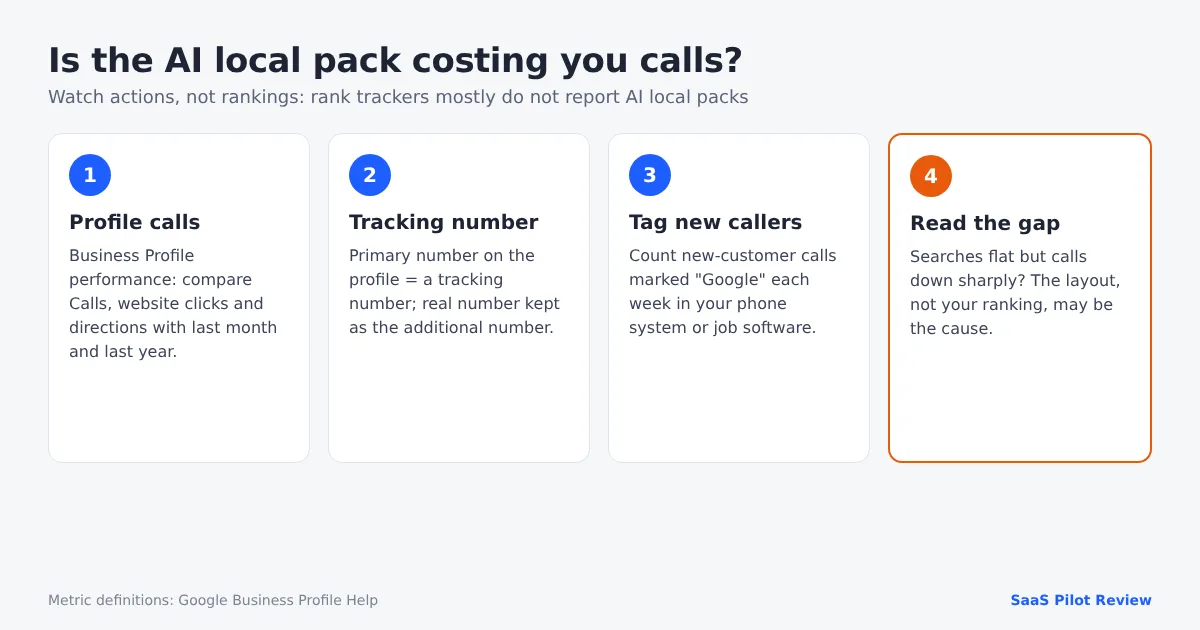
You cannot see the test from a rank report, so watch the actions instead. Three sources give you a before-and-after view.
- Business Profile performance report. Google’s performance help page defines Calls as “the number of times a customer clicked on the call button on your Business Profile,” alongside website clicks and direction requests. Compare November with October and with November last year. Searches falling a little while calls fall a lot is the pattern to watch for. Google removed the per-call history from profiles earlier, so this is a count, not a log; our guide to tracking Google Business Profile calls covers the replacements.
- A tracking number on the profile. A call tracking number set as the primary number on your profile, with your real number kept as the additional number, shows actual call volume, duration and first-time callers from Google. If you are worried about rankings, read our breakdown of whether dynamic number insertion hurts local SEO before you change the number on your profile.
- Your own phone system or field service software. Count new-customer calls tagged “Google” per week. A simple weekly tally in Jobber or a spreadsheet shows a change week by week, while the profile report is easiest to read as monthly totals.
What to do while Google tests this
Do not rebuild anything for a test that may revert next week. These are steps that pay off whichever local pack layout wins:
- Make the profile answer-ready. The AI pack still reads Business Profile data, so categories, services, service area and the business description should state plainly what you do and where. Our guide to getting cited in AI answers lists the fields that matter.
- Put the phone number where the tap lands. If searchers must click through to your site, the number should be a tap-to-call link at the top of every mobile page, not only in the footer.
- Catch the calls you still get. When fewer calls come in, missing one costs more. Our missed call cost calculator puts a dollar figure on it.
- Watch the booking routes Google is adding. Google is also pushing action into its AI surfaces in other ways. AI Mode now books home-service jobs through booking partners, and the Google Business Home beta is changing how owners manage their profiles.
We will update this page if Google comments, if the test spreads to desktop, or if the buttons come back. More news like this is in our local SEO hub, and how we research topics like this one is explained on our how we test page.
Sources
- Search Engine Roundtable: Google AI Overview local pack dropping action buttons, photos and reviews (Barry Schwartz, November 10, 2026), citing Joy Hawkins on X
- Sterling Sky: Google local changes log (entry dated November 10, 2026)
- Sterling Sky, “The State of Local SEO in 2026” by Joy Hawkins (October 26, 2026), linked above
- Google Business Profile Help: Understand your Business Profile performance and insights, linked above
- Search Engine Land column by Michel van Luijtelaar (GMBapi) on local rankings and falling calls, linked above