November 4, 2026 · What changed: since October 1, 2026, Google can charge Local Services Ads advertisers for a missed call made during business hours when the caller stays on the line for more than 20 seconds, voicemail included. Google rewrote its “How leads work” help page in early October to spell out the rule.
If you pay for Local Services Ads (LSA), an unanswered phone now costs money it did not cost before. Under the old rules a call nobody picked up was usually a lost lead and nothing more. Now the same call can be a charged lead and a lost job. The fix is not complicated, but it starts with knowing exactly which calls Google bills, because the rule has several conditions that most write-ups skip.
How we wrote this: researched from Google’s help pages and from trade press reports of the advertiser email, read on November 4, 2026. We have not watched these charges on a live LSA account, so where something is only reported, we say so. Our research and testing method explains how we work.
Which LSA calls are charged now
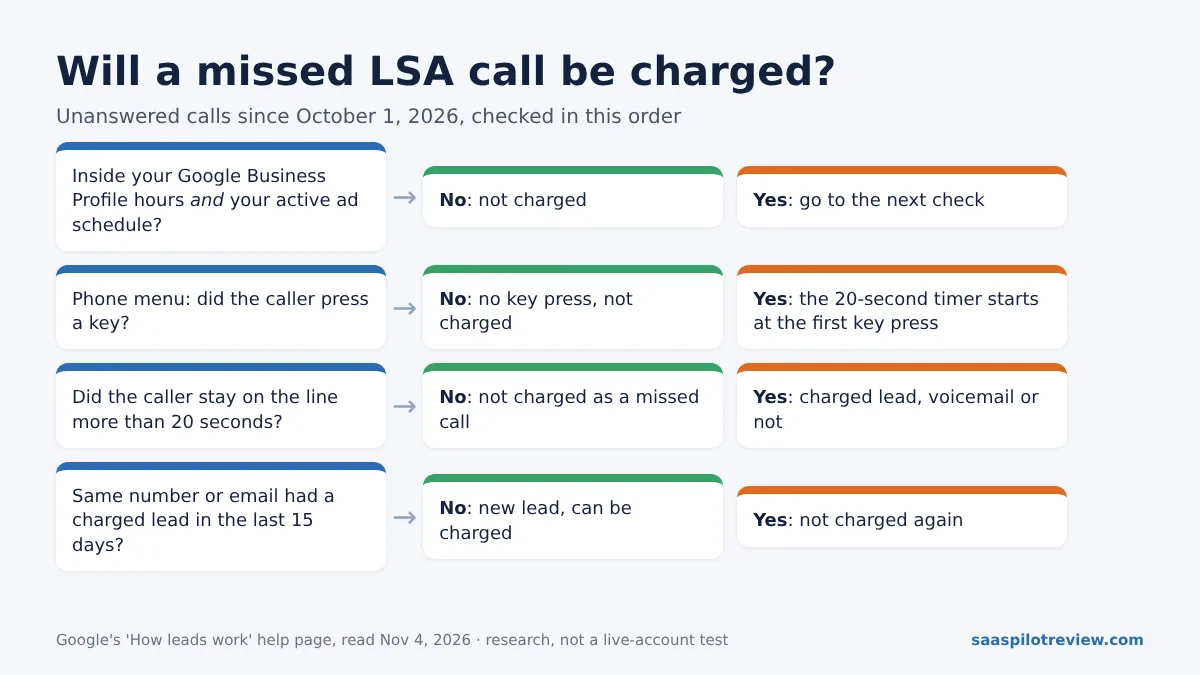
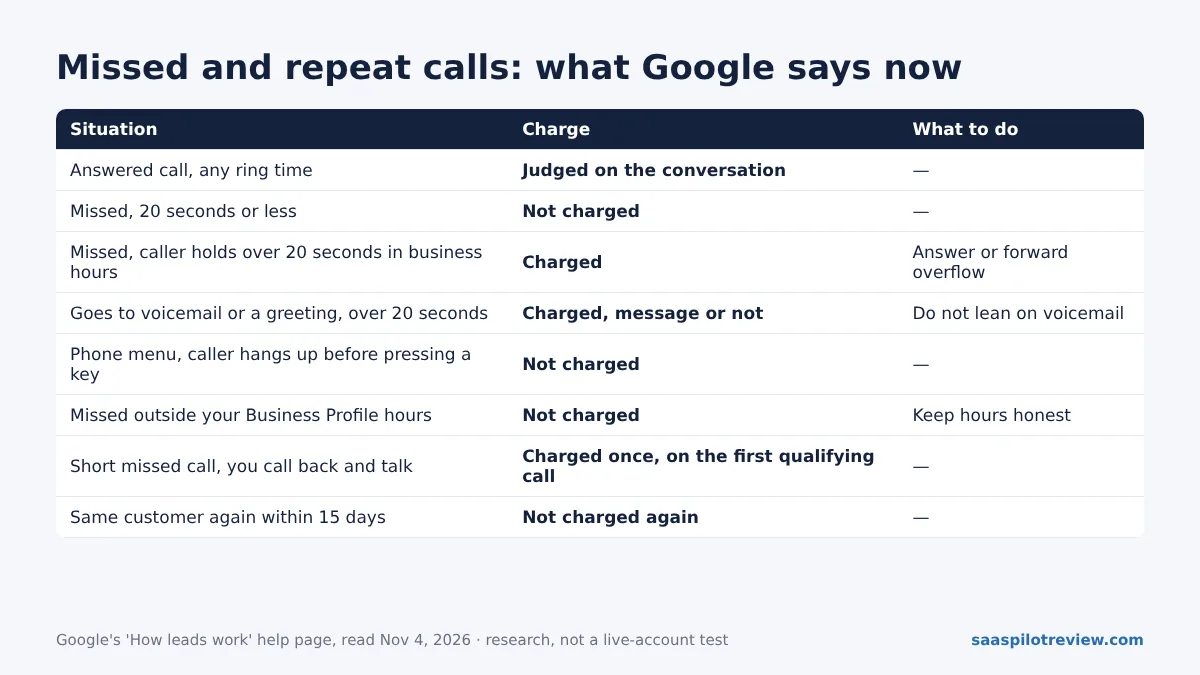
A missed call is charged when three things are true: it comes in during your business hours and your active ad schedule, the caller stays on the line for more than 20 seconds, and it is not a repeat of a lead you were already charged for in the last 15 days. Answered calls are judged on the conversation, as before. Here is how Google’s help page treats the common cases.
| What happens on the call | Charged? | Google’s wording, in short |
|---|---|---|
| You answer, even after a long ring | Judged on the conversation | “you aren’t charged based on the ring time” |
| Missed, caller hangs up within 20 seconds | No | The 20-second rule only applies to missed calls |
| Missed during business hours, caller stays on over 20 seconds | Yes | Counted as a valid lead |
| Goes to voicemail or an automated greeting, over 20 seconds | Yes, message or not | Counts as a connected call during business hours |
| Phone menu, caller never presses a key | No | “You won’t be charged if customers don’t press a key to get routed” |
| Phone menu, caller presses a key and waits over 20 seconds | Yes | The timer starts at the first key press; later presses do not reset it |
| Missed outside your hours or outside your ad schedule | No | Unanswered calls are charged only inside both |
| Short missed call, then you call back and talk | Once | Charged on the first call that qualifies |
| Same number or email contacts you again | Not while the lead is active | No new charge if there is interaction within 15 days; after 15 days of inactivity, a new contact is a new lead |
Rules read November 4, 2026, from Google’s “How leads work” page for Local Services Ads.
Two details catch people out. “Business hours” means the hours in your Google Business Profile, not the hours you think you are open. And a voicemail box that picks up after four rings does not protect you: if the caller listens to the greeting for more than 20 seconds, Google treats it as a connected call.
How the change rolled out
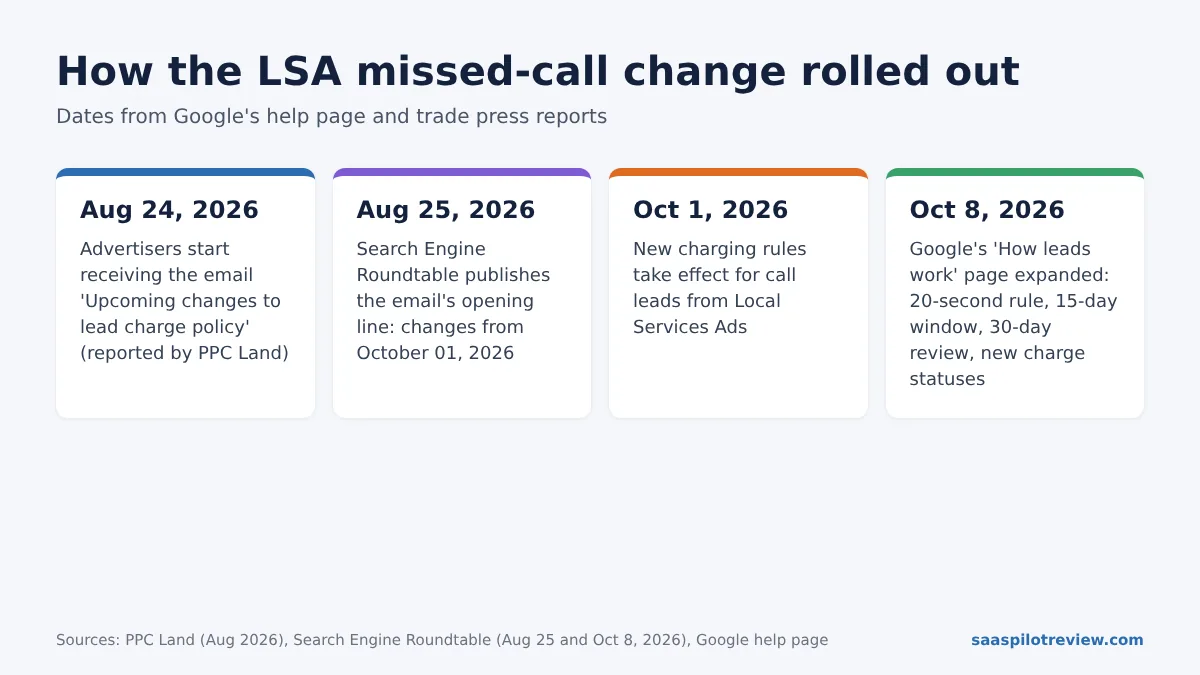
Google told advertisers by email in late August and changed the help page about a week after the new rules started.
- August 24, 2026: PPC Land reported the first deliveries of an email headed “Upcoming changes to lead charge policy.”
- August 25, 2026: Search Engine Roundtable quoted the email’s opening line: “On October 01, 2026, we are updating how and when you are charged for call leads originating from Local Services Ads.”
- October 1, 2026: the new charging rules took effect.
- October 8, 2026: Search Engine Roundtable reported that Google had expanded the “How leads work” page with the 20-second rule, the 15-day window, a 30-day quality review and four charge statuses.
This sits on top of a bigger move. Google is shifting Local Services Ads into Google Ads as Performance Max campaigns with pay-per-lead goals, starting with select U.S. home and storefront service advertisers in August 2026, broader groups in late 2026 and non-U.S. accounts in 2027. The “How leads work” rules apply on both sides of that move. If your account has not migrated yet, our guide on how to track Google LSA calls after the move to Performance Max covers what to save first.
What Google has not explained yet
Some parts of the change are only reported, or not covered at all, on the pages we read:
- Spam protection. The email reportedly promises safeguards against robot calls and spam call abuse, with no detail. The help page says Google’s automated systems filter invalid activity such as spam and duplicate contacts, but does not explain how a robocall that sits on hold for 25 seconds is handled.
- When the clock starts on a plain line. Google explains the timer for phone menus. For a line that simply rings, PPC Land notes the start point is not spelled out.
- Disputes. Google says it assesses lead quality over 30 days and applies credits automatically for poor-quality, duplicate or invalid leads. You can also flag a lead in its Feedback Survey. The page gives no deadline for flagging, and says automatic credits are not available in EEA countries and some verticals.
Seven ways to stop paying for calls you never took
The goal is simple: during the hours Google treats as open, every LSA call should reach a person or a service that can book the job. These steps are in the order we would do them.
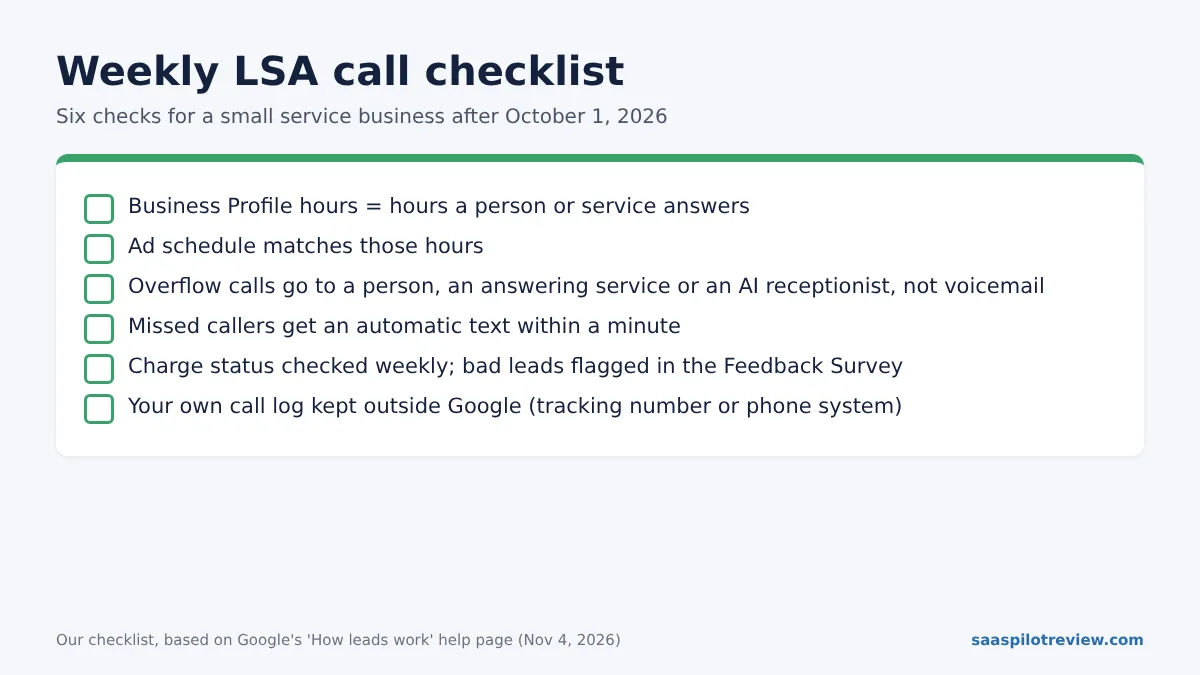
- Make your Business Profile hours match the hours someone answers. If the office phone is unmanned from noon to 1 p.m. or after 4 p.m., either cover those hours or stop listing them. Fake “open 24 hours” listings now cost money.
- Line up your ad schedule with those hours. Unanswered calls are only charged when they fall inside both your active ad schedule and your business hours, so a tighter schedule shrinks the window.
- Do not use voicemail as overflow during the day. A greeting longer than 20 seconds is a charged call. Forward unanswered calls to a person, an answering service or an AI receptionist instead. Our comparison of an AI receptionist or answering service lays out the costs.
- Text every missed caller within a minute. If Google has already charged you for the lead, an automatic text gives you a second chance to win it. Here is how to set up missed-call text back on the phone tools small businesses use.
- Think before adding a “press 1” menu. Google says callers who never press a key are not charged, so a short menu filters out some junk. It also adds a step for real customers, and once they press a key the 20-second timer runs as normal. Keep it to one prompt if you try it.
- Check charge statuses every week. Leads now show as Charged, Not charged, In review or Credited. Flag spam and wrong-number calls in the Feedback Survey for that lead rather than waiting for the 30-day review.
- Keep your own call log. A tracking number on your LSA profile or your phone system’s call history lets you compare what Google charged against what really rang. Since Google already removed call history from Business Profiles, do not rely on Google as your only record.
What a missed LSA call costs you now
Before October, a missed LSA call cost you the job you did not get. Now, during business hours, it can cost you the job and the lead price. Google does not publish one lead price; it varies by trade, location and, for messages, by how likely Google thinks the customer is to book. Open your own lead list and multiply your average cost per lead by the number of unanswered calls over 20 seconds last month. That is roughly what the new rule would have added. To size the lost jobs as well, use our missed call cost calculator.
If your LSA leads already flow into a CRM, check that missed calls arrive there too, so someone follows up on the leads you paid for. Agencies using HighLevel can see our guide to push LSA leads into GoHighLevel, which covers calls, messages and bookings.
Questions owners ask
Am I charged if my phone rings for 30 seconds and then I pick up?
Not because of the ring time. Google says the 20-second rule only applies to missed calls; an answered call is judged on the conversation.
A customer called twice and I missed both. Am I charged twice?
No. Google charges once on the first call that qualifies, and repeat contact from the same number or email is not charged again while there is interaction within 15 days.
Does this apply to message leads?
The 20-second rule is about calls. Messages and emails were already charged leads; Google says message leads are usually priced lower than phone leads, though not always.
More guides on measuring calls are in our call tracking and lead gen hub.
Sources
Read November 4, 2026: Google Local Services: How leads work, Google Ads Help: Local Services Ads transition to Performance Max with pay-per-lead goals, Search Engine Roundtable, August 25, 2026, Search Engine Roundtable, October 8, 2026 and PPC Land on the advertiser email.